

By Anne Rutherford
Simulation in health care is commonplace for learning or practicing skills but the value of simulation jumps to a whole new level when it brings clinical teams together to collaborate on creating standards of practice that will improve the quality of patient care.
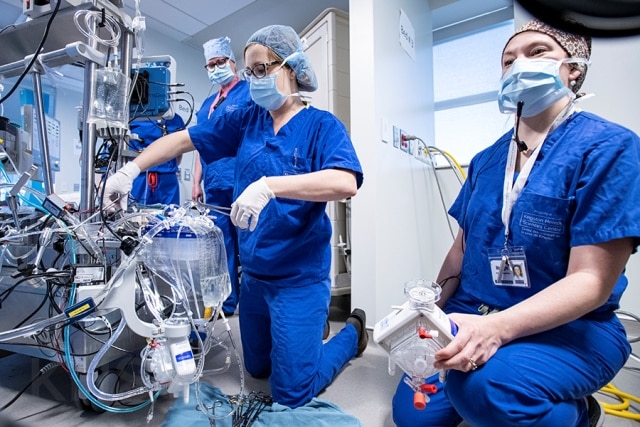
That’s exactly what happened recently when more than 35 participants across all specialties (surgery, anesthesia, perfusion and nursing) from the cardiac surgical team at Kingston Health Sciences Centre huddled for two days of simulations focused on the novel use of the GAMPT Bubble Counter.
The simulation was the first of its kind in the world, says Chief Perfusionist Maggie Savelberg, who led the multidisciplinary effort with support from the Chief of Cardiac Surgery at KHSC and Queen’s University, Dr. Dimitri Petsikas, and the Chief of Cardiac Anesthesia, Dr. Tarit Saha.
The Bubble Counter can calculate the number, frequency and volume of microbubbles in the bloodstream delivered to a simulated “patient” during various scenarios where inadvertent air delivery to the patient during extracorporeal circulation is possible. The Counter provides a direct quality measure of team effectiveness in managing the critical event, and subsequently a new protocol for managing life-threatening embolisms during cardiopulmonary bypass.
Because gas bubbles can block vessels and cause neurological events such as stroke, monitoring and managing their delivery is critical to patient safety, says KHSC cardiac surgeon Dr. Gianluigi Bisleri.
“Fortunately, stroke-related events in cardiac surgery are rare but when they do occur they can have a devastating effect,” he explains. “That makes it critical for us to continuously optimize our practice to improve outcomes.”
It can be difficult to capture data about rare events precisely because they happen infrequently, says Savelberg.
“The beauty of data-driven simulation,” she says, “is that you can repeat the event over and over and actually get objective information that focuses team members on options for improvement.
“With the Bubble Counter simulation we could assess not just how quickly we responded to inadequate oxygenation in the patient but also the quality of the response. Practicing is one thing but also having a way of doing quality assurance so we can fine-tune that practice and improve the standard of care is what lifts our cardiac program above others.”
That boost also comes from having a program where specialists—cardiac surgeons, perfusionists, nurses and anesthesiologists—converge in the simulation environment to collaborate. All levels of expertise accessed the same scenarios to discover where errors happen and how to overcome them.
“Allowing staff to feel, see and evaluate their practice is always a huge opportunity,” says Christine Wilkinson, KHSC Program Operational Director for Perioperative Services. “It lets a new protocol emerge from the clinical team itself, which means everyone is moving forward in the same direction. In this instance, KHSC has the potential to act as a benchmark for other organizations when it comes to safety in bypass surgery.”
The Cardiac program now runs two simulation sessions annually to enhance its quality of service.
“Innovation is not always about a new device,” says Dr. Bisleri. “It can be about making a process better. We’re always striving for improvement. As a standard of practice, simulation is not that common in many health sciences centre but it plays a key role at KHSC in helping us to adopt tools and processes that make surgery safer for our patients.”
For Savelberg, the big takeaway of the simulation was the strong spirit of collaboration focused on concretely improving care.
“I think there was a great sense of insight and purpose about working together to improve patient care,” she says. “People felt respected, involved and capable. When you have that kind of collaboration and genuine appreciation for what each person brings to the work we do, then the magic happens.”