


This month’s special focus on paediatrics includes a number of articles highlighting the impact of COVID-19 on children and youth. This is the first in the section.
Mobilizing a path forward for Canada’s children and youth
By Emily Gruenwoldt
While many jurisdictions across this country begin to feel a fresh sense of hope, for Canada’s eight million children and youth, the COVID pandemic is far from over.
Strict public health measures, necessary to curb transmission of a deadly and highly contagious virus, have taken their toll, and children and youth did not escape unscathed. In fact, children, youth, and their families were impacted disproportionately as schools across the country shuttered, recreational activities, camps, and clubs mostly closed, and many families suffered economic hardship as the result of temporary or permanent job loss.
The consequences of prolonged disruptions in routine, community, social, and health services that are emerging now should be a concern to all Canadians, including our elected officials as they map out this country’s path forward.
In polling conducted by Abacus Data (May 2021), parents reported major concerns for their children’s mental health and wellbeing as the result of prolonged social isolation. Sixty-two (62) per cent of parents noted deterioration of existing mental health disorders, but 48 per cent also reported the pandemic has created new mental health concerns for their children. At the same time, Children’s Healthcare Canada members (children’s hospitals, community hospitals and children’s rehabilitation centres) are seeing evidence of the toll the pandemic is taking on the young patients they care for. Emergency department visits related to suicidal ideation, eating disorders, substance use, anxiety and non-accidental injuries are increasing across the country.
Canadians imagine a better future for their children, and for this reason children’s advocates have been calling for a pandemic recovery plan that prioritizes Canada’s youth and their families. Inspiring Healthy Futures – a collaborative initiative led by Children’s Healthcare Canada, the Pediatric Chairs of Canada, UNICEF Canada and the Canadian Institutes of Health Research – Institute of Human Development, Child and Youth Health engaged over 1,500 youth, family partners, researchers, community and health service providers, policy leaders, and educators to co-create an integrated set of priorities for systemic change, in order to measurably improve the health and well-being of Canada’s children, youth and families. In short, these five interlinked priorities include:
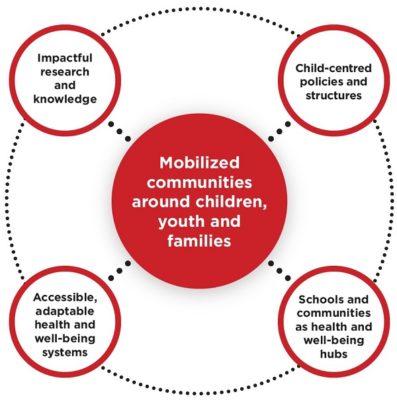 Comprehensive, cross-disciplinary research: Adopting a life cycle approach to understanding health and well-being from pre-conception through to later life, embracing an equity lens to consider and evaluate unique circumstances of at-risk and marginalized populations.
Mobilized Communities: Children, youth and families must be connected around issues that matter, where their lived experience is fully valued and included in research, policy decisions and community action. Infrastructure to amplify peer support opportunities, promote opportunities for youth engagement and participation, and build capacity for youth led change and advocacy is critical.
Accessible, adaptable health and well-being systems: All children, youth and families should have timely access to an integrated, family-centred system of physical and mental health services and benefits, flexible to each family’s needs. Integrated health and social service records, accessible to parents and health service providers would support a more wholistic approach to care for children. More systemically, Canada requires a consistent and comprehensive data set – comparable across jurisdictions and linked to education – to measure children’s health, healthcare, and health outcomes.
Schools and communities as health and well-being hubs: Schools and communities must evolve to be dynamic hubs to connect parents, child and youth to the resources, outdoor, social, and recreational spaces kids need to thrive. Every child should have access to child care, quality early learning, developmental and social care, and necessary diagnoses, therapy, and early interventions, where parents and caregivers are fully engaged as partners and peer supports.
Child centred policies and structures: Canada must increase the will and capacity of governments at every level to incorporate child-friendly decision-making protocols and practices. This means coordinating policies across federal, provincial, and territorial jurisdictions, incorporating child impact assessments, and improving data and outcomes monitoring. It also means establishing a non-partisan federal accountability office for children and youth, guided by their voices, and fully respecting and advancing the rights and self-determination of First Nations, Métis and Inuit children and youth.
The COVID 19 pandemic has provided an unmissable opportunity to act: to act on behalf of Canada’s children and youth to rewrite the rules for the policy, investment, innovation, and partnerships needed for kids to thrive. It means working together in new, unrelenting ways to create a more integrated and decolonized system of health, social services, and social protection. Inspiring Healthy Futures is a launching point for

mobilizing our path forward, harnessing the energy, commitment, and resources of a community – a country – passionate about our 8 million children and youth. It’s a vision and commitment whose time has come.
Learn more about the Children’s Healthcare Canada at childrensh
ealthcarecanada.ca and the Inspiring Healthy Futures initiative at inspiringhealthyfutures.ca.
Emily Gruenwoldt is President & CEO, Children’s Healthcare Canada; and Executive Director, Pediatric Chairs of Canada.