

By Amber Daugherty
When you visit the hospital, you’re there to get healthy – not to catch something that makes you sicker. But more than 220,000 people get hospital-acquired infections every year in Canada because of being in close proximity to others who are ill. It’s important that healthcare teams continue to evolve their cleaning practices to prevent the spread of bacteria in hospitals so that patients recover faster and staff members stay healthy.
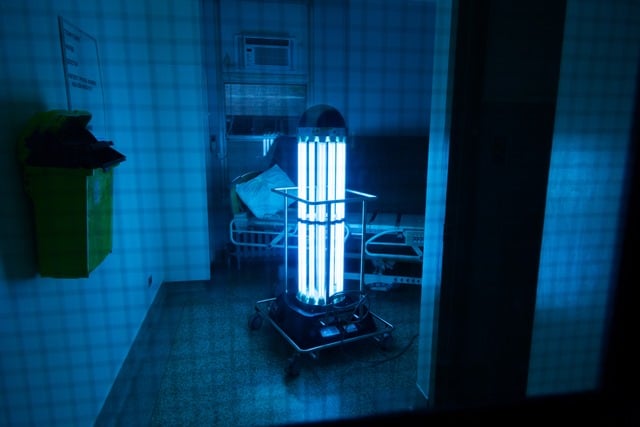
At St. Joseph’s Health Centre Toronto, our environmental services team has introduced a new piece of equipment that’s radically changing the cleaning game. After manually cleaning the room using best practices, our team wheels a machine called the Tru-D SmartUVC (or “Trudi”) into the room. It uses sensors to calculate how much time it will take to disinfect the room, looking at factors including overall size and objects in the room. Once everyone is out, the door is closed and the machine delivers a precise dose of UVC light that’s known to kill bacteria including influenza, norovirus, C. diff, MRSA and others that can spread through hospital environments.
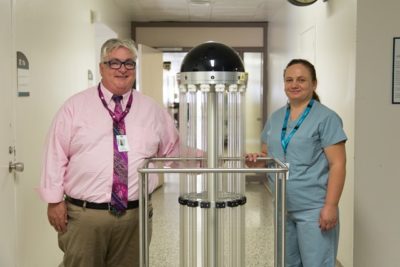
“Introducing technology like Trudi is incredible because it acts as an additional layer on top of the cleaning practices we already have in place,” said Michael Rotstein, Infection Prevention and Control Manager. “It allows us to guarantee our patients and staff that we’re taking an extra step to protect their health.”
How does it work?
When UVC light hits bacteria, it essentially deactivates it, making the bacteria unable to infect or reproduce. Because of the machine’s unique design, it’s able to cover every inch in a space, even bouncing around corners and underneath equipment – so it can clean an entire room without having to be moved.
“Our staff are specially trained to use this piece of equipment,” said Carlo Sebasta, Environmental Services Supervisor. “And while we’re currently using it in patient rooms, we’re also working on getting it into the Operating Room to do a final disinfection after the suites have been cleaned at the end of the day.”
The machine is also being used to clean equipment that’s shared by staff, including mobile work stations and patient tools and supports including wheelchairs and walkers – items that can often be the culprit for diseases spreading between patients in a hospital setting.
“When patients are in hospital, they’re impacted by the spaces that they receive care in,” says Sebasta, “so we want to make sure their rooms and any equipment that’s being used on or around them are also contributing to their recovery.”
Amber Daugherty is a Communications Associate at St. Joseph’s Health Centre Toronto.
Comments are closed.