

Health leaders say racism and discrimination need to be addressed in healthcare
By Ryan Joyce
In a world where we regularly wake up to headlines announcing innovations that break down scientific barriers in health care, it can be hard to comprehend why some communities still face barriers to access basic care solely based on their race.
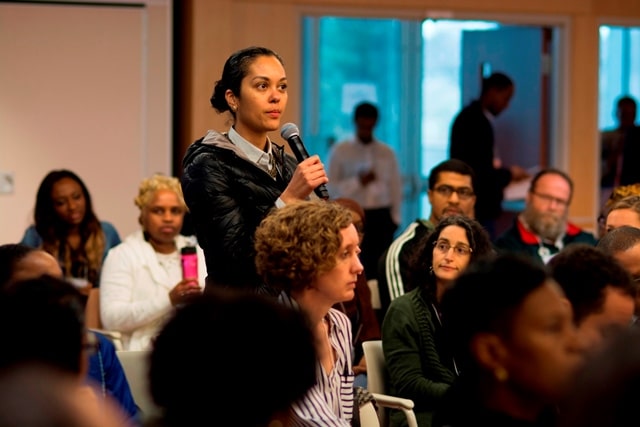
To help address this inequity, Sinai Health System and the Black Experiences in Health Care committee (which includes the Black Health Alliance, the Wellesley Institute and TAIBU Community Health Centre), hosted the Black Experiences in Health Care Symposium earlier this year. The symposium aimed to identify and raise awareness of issues relating to health inequities faced by black Ontarians, and over 130 health care providers, academics, advocates, patients/clients and members of the community participated. The event received support from Toronto Central LHIN, one of 14 provincial planning and funding agencies.
The health needs are unique for this population and other racialized groups. Black communities have high rates of diabetes, mental health, HIV/AIDS, heart disease, sickle cell, stroke and hypertension. If not adequately addressed, these challenges can lead to poor patient outcomes, and strain the health-care system.
Serena Thompson, a sickle cell patient, brought these challenges to life when she spoke at the symposium. “On a number of occasions, I have felt that I am not treated like other patients because of my race,” says Serena. “My disease causes me extreme pain and the only relief is medication, but health care providers often take one look at me and assume I am only there for drugs. So, while I am in pain I have to advocate for myself and I feel pressure to act or dress a certain way to be taken seriously.”
Racism and other social determinants of health exacerbate the issues Serena and others face. “When we think of complex patients, we picture an aging population with multiple chronic diseases,” says Dr. Gary Newton, Sinai Health System’s President and CEO. “It’s important we all understand that inequity and racism are disease equivalents in terms of their impact. They contribute to complexity and poor outcomes in the same way diabetes and hypertension do.”
A new report that emerged from the symposium suggests these challenges can be greatly reduced with targeted solutions, and makes recommendations for hospitals, community health centres, primary care providers, the Ministry of Health and Long-Term Care, LHINs, Health Quality Ontario and police.
System level approach
The report recommends that Ontario’s Ministry of Health and Long-Term Care sets system-level accountability, together with LHINs and Health Quality Ontario. Proposed solutions include the development of a fully funded black health strategy, a separate strategy for more funding for black community mental health services, and funding to create culturally safe spaces for this community.
The report also recommends that Ontario’s Ministry of Health and Long-Term Care and its LHINs can hold local health care providers accountable for the collection of socio-demographic data and race-based health-related data, and mandate health equity training across the province.
Some are ahead of the curve. On behalf of the Toronto Central LHIN, Sinai Health System leads a transformative and first-of-its-kind Canadian effort to mandate the standardized collection of demographic data from patients and clients. Currently, all hospitals and community health centres within this LHIN are mandated to participate in this initiative.
Equity across the continuum of care
The report recommends addressing racism in hospitals, community health centres and primary care providers. “Health-care providers can mitigate racial health inequities by being aware of how unconscious bias can affect diagnoses and treatment, and involving diverse groups of patients in designing our services and spaces,” says Marylin Kanee, Sinai Health System’s Director of Human Rights and Health Equity. “Hiring staff that represent our population and offering training around health equity, cultural safety and anti-oppression at all levels within health-care organizations will also help move the marker on improving health outcomes for marginalized communities.”
Impact of policing and mental health
The report also calls for continuous education for police officers about racism and mental health, accountability for police violence, and the development of mental health and trauma response teams to correspond with 911 calls.
Sinai Health System’s and the Black Experiences in Health Care committee’s first symposium is just the beginning of an important, ongoing conversation. In the future, participants from the symposium would like several other topics to be discussed, such as barriers faced by black youth and black LGBTQ+ people, and intersections between black and Indigenous experience.
The full report is available on Sinai Health System’s website at sinaihealthsystem.ca.
Ryan Joyce is a Communications Specialist at Mount Sinai Hospital, part of Sinai Health System.