
By Joe Gorman
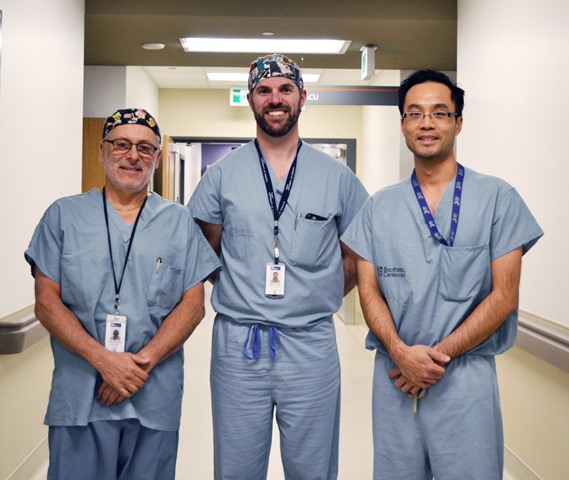
In a Canadian first, Humber River Hospital surgeons, Dr. Steven MacLellan and Dr. Jensen Tan, perform Ventral Hernia Repair and Abdominal Wall Reconstruction using the da Vinci Surgical Robot System.
The operation that would normally require a major incision to reach the organ, can now be done using a minimally invasive approach. As a result, patients experience significantly less pain, less scarring, shorter recovery time as well as a faster return to normal daily activities.
“A hernia can drastically impact someone’s quality of life,” Dr. MacLellan said, “We are excited to make an impact and improve outcomes for our patients. We’re in a good position to do that at Humber, with our existing robotics program and with the support we are receiving from the Hospital and from nurses and physicians who have experience using the da Vinci.”
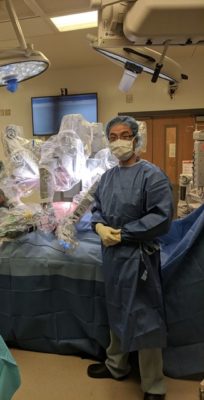
The da Vinci Surgical System is a sophisticated robotic platform designed for complex minimally invasive surgeries. It features an ergonomic console where the surgeon is allowed to view high-definition 3-D video from a camera inside the patient. From the da Vinci console, surgeons control four interactive robotic arms equipped with precision instruments. Powered by state-of-the-art robotic technology, the da Vinci System mimics the movements of the surgeons’ hands while filtering out even the slightest tremors.
Thanks to a transformational donation in 2012, the da Vinci Surgical Robot is the centrepiece of the Murphy and Helen Hull Robotics Centre at Humber River Hospital.
Barbara Collins, CEO and President of Humber River Hospital states, “Our commitment to perform an ever-increasing variety of surgical procedures using high tech robotics is all about providing the most advance quality of care to our patients and ensuring surgeons have access to that equipment.”
Dr. Tan added, “Today went very well. We were fully prepared. We have both had a lot of practice with the robot, and we made sure to address how the operation would flow beforehand.”
Joe Gorman is the Director, Community Relations at Humber River Hospital.