

By James Wysotski
St. Michael’s is the first hospital in Canada to have performed a novel catheter-based valve replacement technique that allows cardiac patients to go home the next day instead of staying in hospital for up to 10 days.
Valves created from animal tissue often begin to fail 10 to 15 years after surgery, either becoming leaky or narrowed. Usually, patients needing a replacement of these “bioprosthetic” mitral valves have two options: they can undergo open-#heart surgery again or a procedure known as a trans-apical mitral valve replacement where the physician inserts a catheter between the ribs to replace the mitral valve on the still-beating heart.
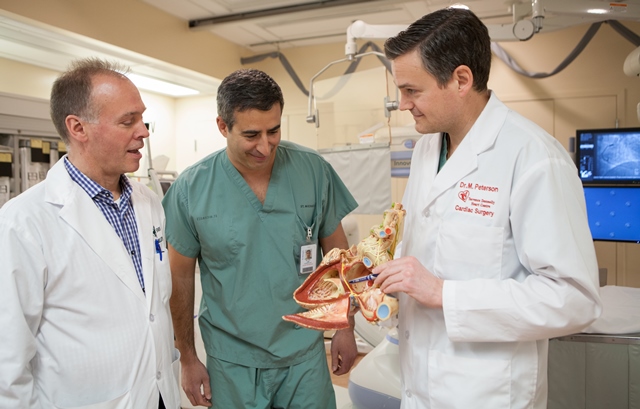
While both viable options, a much less invasive mitral valve-in-valve procedure has been performed by Dr. Neil Fam, an interventional cardiologist and medical director of the Cardiac Intensive Care Unit, Dr. Mark Peterson, a cardiovascular surgeon and co-director of the Transcatheter Aortic Valve Program, and Dr. Chris Buller, director of Interventional Cardiology. Dr. Fam said he hoped this would become the standard of care for the appropriate patient.
“No major arteries are cut into,” Dr. Fam said. “There’s no heart incision. There are no chest tubes. There’s none of that. It’s such a safe procedure.”
Last fall, Drs. Fam and Peterson treated a 72-year-old man with severe mitral regurgitation caused by a leaking bioprosthetic mitral valve replacement from 1998, that was allowing blood to flow backward toward the lungs. After entering a catheter through a vein in the man’s leg and going up into the right atrium of his heart, they went through an inner wall – the interatrial septum – into the left atrium, placing the catheter deep inside the heart and right above the failing valve.
By placing a new valve inside the old one, the patient was left with only a small puncture in his leg. The procedure took less than an hour and the patient went home the next day. Dr. Fam said the man has been seen in follow-up appointments and is doing great. The physicians have since performed the procedure on a second patient.
While the method of entering the body through a leg vein has been used in other heart procedures for decades, none used the #transseptal (across the septum) approach until now. In the near future, Dr. Fam said he hoped to improve upon a North American first performed here in May 2014 when the heart team did a trans-apical native mitral valve replacement. Next up, he said he hoped to do the same replacement using the transseptal approach, refining a procedure performed just once in the world earlier this year.
“Eventually, we won’t be going through the apex of the heart so much, and certainly less open-heart,” said Dr. Fam. “Transseptal procedures will provide more options for patients and hopefully makes things a lot safer with faster recovery.
James Wysotski is a Communications Adviser at St. Michael’s Hospital.