

By Julie Dowdie
For Navaratham Murugasu, Breathe Better at Home could not be a more suitable name for the program he’s been a part of at Markham Stouffville Hospital (MSH).
Murugasu, who suffers from Chronic Obstructive Pulmonary Disease (COPD), is one of more than 100 patients who have participated in the pilot program run out of MSH’s Centre for Respiratory Health and COPD clinic since April 2018.
“Before I joined the program, I used to visit the Emergency Department (ED) two or three times a year and once spent nearly two weeks in hospital,” said the 79-year-old Markham resident who developed COPD shortly after a stroke in 2008.
“However, since I’ve been a part of it, I haven’t visited the ED once in over a year.”
“COPD is a common, preventable and treatable lung disease characterised by persistent respiratory symptoms and airflow limitation. It encompasses conditions such as emphysema and chronic bronchitis,” said Dr. Allen Greenwald, Mr. Murugasu’s respirologist, who began treating him prior to starting the Breathe Better at Home program.
“As a progressive and incurable disease, COPD requires close monitoring of symptoms to avoid ongoing visits to the ED and prolonged inpatient stays. The Breathe Better at Home program allows patients to play an active role in their own care journey, while also having access to an interprofessional health care team.”
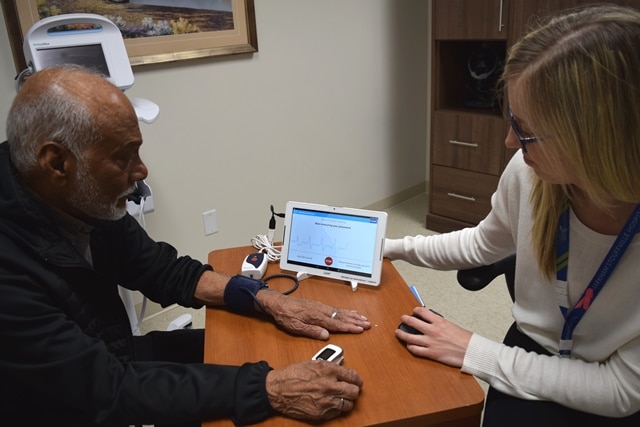
Patients take on this self-management role through a partnership between MSH and Cloud DX using innovative chronic disease management technology from Cloud DX. A downloadable application allows patients to regularly measure their vital signs, including oxygen saturation, blood pressure, heart rate, and weight – all from the comfort of their own home. Their results are monitored by their care team through a clinician portal. Early warning signs allow patients and clinicians to address issues before the patient’s health worsens.
Murugasu has truly appreciated this comprehensive team-based approach, especially the care he has received from his main point of contact, Clinical Project Specialist Katrina Engel – who he affectionately calls “Madame Katrina.”
“Madame Katrina, as well as everyone else at Markham Stouffville Hospital, has been very dedicated and helpful in coordinating my care,” he said.
“If there’s a flare up of my COPD, Madame Katrina immediately calls me or sends me an email and lets me know what needs to be done next. If it gets worse, she arranges a follow-up appointment with a doctor.”
“Having a clinician such as myself work with patients using the Cloud DX application has so many benefits for both them and our health care system,” said Engel.
“By identifying the patient’s needs and connecting them with the necessary health care resources early on, they feel supported. Monitoring and managing the patient’s care remotely and not bringing them into the hospital unless necessary also reduces costs to our health care system.”
A recent analysis of the Breathe Better at Home program conducted at MSH reaffirms Engel’s comments and shows a number of positive results. Inpatient admissions and Emergency Department visits related to COPD decreased in the six months following enrollment in the program. The program has also demonstrated some potential cost savings, as patients with COPD who are admitted may have shorter lengths of stay.
As well, from a patient experience perspective, up to 83 per cent of patients enrolled in the Breathe Better at Home program said they would continue with it.
With such successful results, the team is now looking to expand the program to congestive heart failure patients, those with high blood pressure, and patients with multiple chronic illnesses.
Murugasu is excited others will have access to the program. “I’d tell anybody who needs it to take advantage of this incredible program and I hope others will find it as valuable as I have.”
Julie Dowdie is a Senior Communications Specialist with Markham Stouffville Hospital