

Funding from three generous donors to help 350 medical residents annually through
education, research and hands-on simulation training
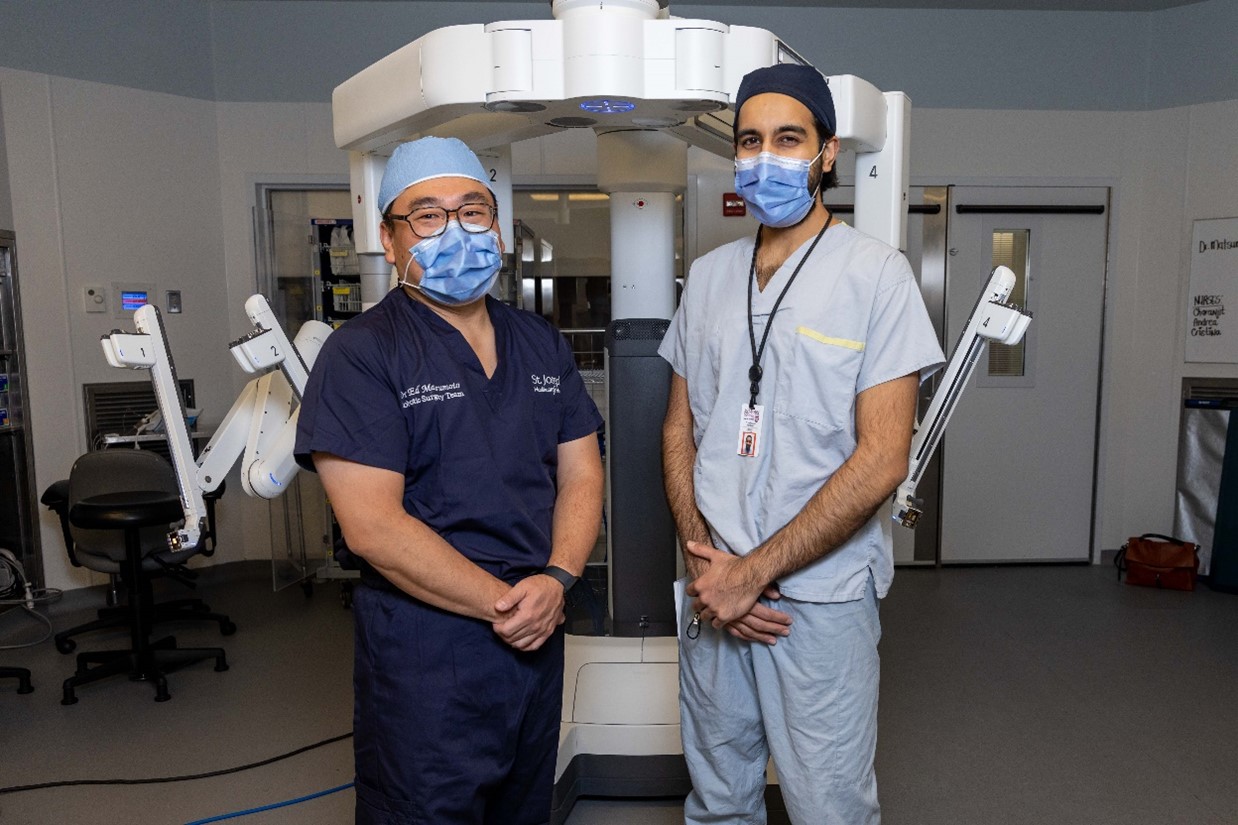
Have you ever wondered how a medical student becomes an operating room surgeon? Dr. Eddie Matsumoto knows. He’s a renowned urologist, a robotic surgeon and Director of the Fellowship Program within the Division of Urology at St. Joseph’s Healthcare Hamilton. Thanks to one million dollars in recent donations, Dr. Matsumoto is spearheading a research and education program which is helping medical trainees become the surgeons of tomorrow.
St. Joe’s is an academic health sciences centre affiliated with McMaster University. Each year, the Hospital welcomes an average of 350 graduating physicians to complete their residency rotations.
A $500,000 donation from The Wilson Foundation, a private foundation established by former telecom executive and well-known philanthropist Dr. Lynton (Red) Wilson, augmented by $250,000 from an anonymous charitable foundation and a $250,000 donation from Stresscrete founder and Stoney Creek resident Michael Schwenger totals one million dollars in philanthropic investments designed to ensure the next generation of surgeons is training on the newest technology and evaluating the latest techniques so they can not only maintain current standards of patient care but advance them.
“These generous gifts are helping to hone and expand a research and education program that includes Canada’s first Urology Boot Camp for surgical residents right here at St. Joe’s,” Dr. Matsumoto says. “Working with international experts, we’ve created a curriculum that offers first-year residents intensive training using safe and effective simulation labs and technology that have a measurable impact on both reducing their learning curve and improving the care of the patients we serve.”
In the boot camp’s first year, surgical trainees participating in the program showed vast improvements in their surgical knowledge by scoring an average of 91 per cent on the post-training questionnaire versus 62 per cent before undergoing training. Dr. Matsumoto leverages the Hospital’s new Centre for Education, Learning & Simulation to offer students the chance to perform procedures and “operate” on high-fidelity mannequin “patients” in a safe and controlled environment.
Surgical residents are encouraged to test drive laparoscopy and endoscopy simulators; try their hand with a catheter insertion model, and leverage virtual reality, 3-D printed kidneys, and point-of-care ultrasound (POCUS) technology to build hands-on skills to complement their academic, scientific and anatomical knowledge. The end goal is two-fold: residents who emerge from their training knowing how to safely leverage all of these tools to diagnose and treat urologic conditions; and evaluating the procedures and technology surgeons currently use to evaluate their effectiveness and look for novel ways to improve care for patients.
A philanthropist with a penchant for supporting education, Dr. Wilson says he was inspired to make this six-figure gift after hearing Dr. Matsumoto talk about how he could help medical trainees to gain a surgical and diagnostic skill set sooner through experiential education.
“As we age, we become more frequent users of the healthcare system,” says Dr. Wilson, who’s now 83. “I view this donation as a strategic investment in making sure the people who will be caring for us and our loved ones not only have access to the latest knowledge and technology, but they emerge from their education knowing how to use it to help their patients.”
Fellow donor Michael Schwenger is a grateful patient of Dr. Matsumoto’s. “Eddie is a national leader in urology. But it’s his skill combined with his bedside manner and his commitment to continuous improvement that truly differentiates him,” says Mr. Schwenger. “As a patient, he gives me straight answers and explains my treatment options in a way that makes me feel empowered to make my own informed decisions. We need more medical professionals like him. And one of the best ways we can accomplish that is by investing in a program designed to instil both skills and a thirst for innovation in our future healthcare professionals.”
Dr. Hark Randhawa is a resident physician currently completing his training in Urology at St. Joe’s. While at the Hospital, Dr. Randhawa was trained on how to perform urologic procedures using the da Vinci XI surgical robot. St. Joseph’s Healthcare Hamilton is one of only a handful of centres in Canada with a full-fledged robotic surgery program that has garnered the hospital international renown. Robotic surgery is fast becoming the standard of care for urologic surgeries worldwide, but in Ontario, to date, has largely been made available through philanthropy.
“By completing my surgical residency here at St. Joe’s, I feel like I have a huge advantage, and I’m grateful to the donors and the physicians who’ve invested in me,” says Dr. Randhawa. “I’ve had real-time exposure to hands-on learning under the guidance of leaders in the field like Dr. Matsumoto and his colleague, Chief of Surgery, Dr. Bobby Shayegan. It’s given me greater confidence as I transition from training to independent practice to have had mentorship from experts in minimally invasive surgery. As robotic surgery evolves as a standard of care in Canada, I’ll be better equipped to offer the most advanced care to our patients locally.”
Dr. Matsumoto’s Robotic Surgical Education and Research Program remains a fundraising priority for St. Joseph’s Healthcare Foundation. The Foundation hopes to raise $2 million to support the education of future surgeons and is now halfway towards its fundraising goal.