
By Carrie Stefanson
When a person experiences interpersonal violence, Fraser Health’s dedicated and compassionate staff support them with timely medical-forensic care and services.
These services typically include medical care and follow up of injuries, forensic examinations, screening and treatment for infections and injuries, emergency contraception (including IUD insertions), pregnancy testing, vaccinations, blood and urine tests, prescriptions and referrals to specialists and community resources as needed. Patients seen by forensic nurse examiners in the emergency department of Surrey Memorial Hospital and Abbotsford Regional Hospital receive follow up by phone or in-person appointments by the Nurse Practitioners at Embrace Clinic.
With increasing concern around the role of strangulation in interpersonal violence, a Strangulation Clinic is one of the newest services offered at the Embrace Clinic in Surrey.
“A woman who is strangled by her domestic partner is at 700 times more risk to be killed by her partner and that is profound,” says forensic Nurse Practitioner Hannah Varto, who recently completed advanced training in strangulation assessment and care from the Training Institute on Strangulation Prevention.
“We realized we needed a specific service that addresses the medical and social impacts of this terrifying and serious type of violence and we wanted to name it, the same way you would name a diabetes clinic or concussion clinic. We can provide a thorough assessment, both medically and forensically, meaning the evidence that might be helpful in court. “
The Embrace Clinic is also contributing to research. Both Varto and forensic Nurse Practitioner Jennifer Ehirchiou are involved in a project that examines how the brains of women who have experienced strangulation and or concussions at the hands of their partners. Strangulation can result in an anoxic brain injury from lack of oxygen going to the brain during the event.
“Women who’ve been beaten repeatedly by their partners may never have been told they have a concussion, never received concussion management, even though their sleep, concentration and emotions may be impacted by a change in their brains,” says Jennifer Ehirchiou.
“Brain injury in victims of domestic violence is often overlooked,” says NP Hannah Varto. “We’re working really hard to change that.”
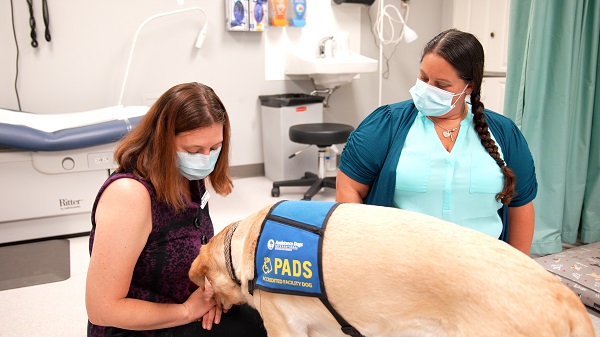
Embrace Clinic opened in 2015 and was mobile until 2021, when it secured a home across from Surrey Memorial Hospital. And nothing says home quite like a dog. Levi, a Pacific Assistance Dogs Society (PADS) Accredited Facility Dog, recently joined the team to support survivors in a way that only a trained facility dog can.
Carrie Stefanson is a Senior Public Affairs Consultant, Fraser Health.