

By James Wysotski
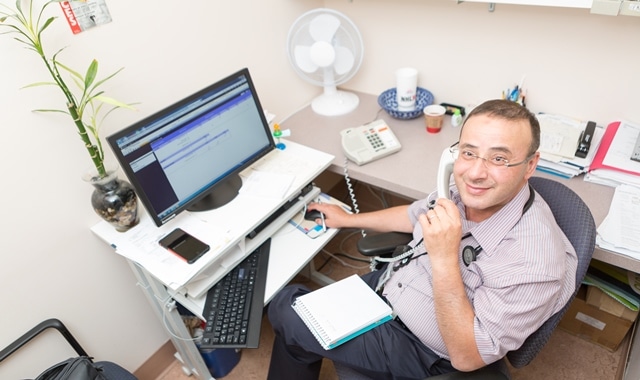
Patients at the Heart Failure Clinic know help is just a phone call away.
If they notice sudden leg swelling or shortness of breath, the clinic’s nurse practitioner, Haytham Sharar, can advise them.
But what if they don’t recognize these symptoms of congestive heart failure?
A recent quality improvement initiative pursued by Ada Andrade, a nurse practitioner in the Heart and Vascular Program, helped people who didn’t realize they needed it.
While on placement at the Ottawa Heart Institute in 2013 during her master’s in quality improvement and patient safety, Andrade was inspired by the hospital’s remote monitoring of discharged patients. With the goal of reducing readmission rates, she envisioned adapting it for St. Michael’s Hospital.
Sharing the same goal, the Ontario Telemedicine Network and the Community Care Access Centre partnered with St. Michael’s heart failure team in a six-month pilot program that ended in June.
Using OTN’s remote-monitoring equipment, a CCAC nurse checked in daily with patients discharged from St. Michael’s and followed in the heart failure clinic. If signs and symptoms of heart failure and deterioration were detected, the nurse contacted Sharar so that he could call the patient to confirm and determine if a visit to the clinic or other steps were required for further tests or a change in medications.
Primarily elderly patients with comorbidities, “some didn’t realize they had developing problems that were worthy of a call or visit, like weight gain or swelling,” said Sharar. Through this increased monitoring, they received help before problems got out of hand.
With fewer than 10 patients recruited to the program, the sample size may be too small to make generalizations about its effectiveness at lowering readmission rates, said Andrade. Data won’t be available until later this fall.
Regardless, both Andrade and Sharar know the program improved the patient experience.
“The patients love it, but more importantly, so do the caregivers,” said Sharar. “They have an extra eye looking at their loved ones and they know there is somebody there they can rely on and call any time. This gives them relief.”
James Wysotski is a Communications Adviser at St. Michael’s Hospital.