

By Mariela Castro
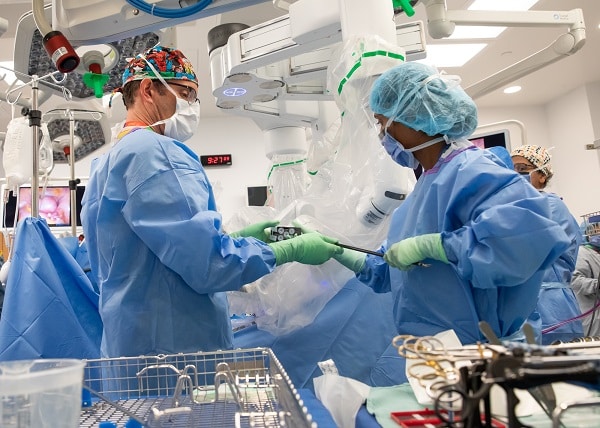
Robotic surgeries are elevating surgical care at Mount Sinai Hospital, and the four-armed robot enabling better patient outcomes is called LEO.
As a fourth generation da Vinci Xi model, it is the most advanced surgical robot in Toronto and one of few in Ontario.
Affectionately nick-named LEO by hospital staff as a tribute to Leonardo Da Vinci’s impactful technological innovations and work with the human body, it is transforming the field of minimally invasive surgery.
Part of the da Vinci Surgical System, the robot translates a surgeon’s hand movements at a console in real time, bending and rotating surgical instruments while performing the surgical procedure. It allows for more precision, flexibility and control than possible with more conventional surgical techniques.
The da Vinci robot and Surgical System were unveiled as part of the innovative Robotics Suite on the Hospital’s new state-of-the-art Operating Rooms and Surgical Services Floor, and are facilitating complex laparoscopic operations on patients with complicated health concerns.
Dr. Jonathon Solnik is Head of Gynaecology and Minimally Invasive Surgery, and an internationally recognized leader in his field. He was one of the first Mount Sinai surgeons to use the robot, having experienced the benefits of robotics-assisted surgeries first-hand during his tenure as a surgeon in the United States.
“Laparoscopy surgery affords patients specific benefits ─ shorter recovery, less pain, an earlier return to normal activities and quality of life,” he said. “Using a surgical robot enables an extremely precise type of laparoscopic surgery. Traditional laparoscopic instruments twist and open. But the robot gives you wrists ─ wristing motions enabling seven degrees of rotation that traditional laparoscopic instruments don’t. So it allows you to more safely reconstruct organs, which can be quite difficult with traditional laparoscopic surgery.”
With the “wristing” motions afforded by the robot, the same laparoscopic surgeries can be extended to additional groups of patients with specific health conditions, such as women with some types of reproductive cancers.
Robotics is taking surgical care to a higher level. As a hospital world-renowned for its surgical program, Mount Sinai already has superbly-trained surgeons conducting minimally invasive surgery on patients with complex health concerns. Now, surgical teams can take care of more patients with complicated health conditions in a minimally invasive fashion.
The Robotics Suite is one of the many advancements of Renew Sinai, the largest and most ambitious redevelopment in the Hospital’s history. Robotics-assisted surgeries are available for gynaecology and urology patients.
Mariela Castro is the Redevelopment Advisor, Capital Development at Mount Sinai Hospital.