

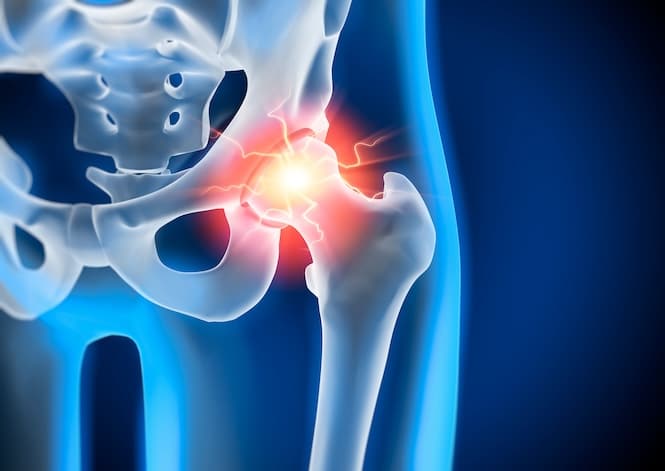
Patients who develop a periprosthetic joint infection (PJI) after a total hip replacement have more than a five-fold increased risk of mortality within 10 years, according to new research published in the Journal of Bone and Joint Surgery.
In one of the largest studies to date of patients with PJI after total hip arthroplasty (THA), researchers from ICES, Sunnybrook Research Institute and the Department of Surgery at the University of Toronto’s Temerty Faculty of Medicine looked at the long-term (10 year) mortality risk of PJI for 175,432 adults receiving their first hip replacement in Ontario, Canada. The study was funded by ICES and Arthritis Society Canada.
About 1 in 7 Canadian adults live with osteoarthritis, a number that is expected to grow as baby boomers age and life expectancies increase. Joint replacement procedures can lessen pain and improve quality of life for people who are dealing with this progressive disease.
“Most hip replacement surgeries are very successful, but unfortunately, about one to two percent of patients develop infections of the prosthetic joint. It is well established that such infections impact patient health over the long-term, but this research provides compelling evidence that it can even lead to death,” says lead author Dr. Raman Mundi, an assistant professor in Temerty Medicine’s Department of Surgery and a surgeon-scientist in the Division of Orthopaedic Surgery at Sunnybrook Health Sciences Centre.
The researchers found that among adults receiving their first hip replacement from 2002 to 2021, 868 patients (0.5%) required further surgery for a PJI within one year of hip replacement.
Patients with a PJI within the first year had a significantly higher 10-year mortality rate than those who didn’t develop an infection (11.4% versus 2.2%)
“Our findings underscore the need for arthroplasty surgeons and infectious disease experts to work together on prevention efforts and follow best practice guidelines for patient care,” says senior author Dr. Bheeshma Ravi, an adjunct scientist with ICES, surgeon-scientist with the Division of Orthopaedic Surgery at Sunnybrook Health Sciences Centre and assistant professor of surgery at Temerty Medicine.
The authors provide several reasons for why they believe the association between PJI and mortality is likely causal and not correlational. First is that the association was quite strong, with the authors controlling for variables such as age, sex, income and health status. Second is that there is precedent that major orthopaedic events (for example, hip fractures) can directly increase risk of mortality. And finally, this study builds on existing evidence that used smaller cohorts of patients and shorter follow-up times.
“Ultimately, we need to develop effective strategies to prevent and cure these infections to reduce the long-term risk to patients,” adds Ravi.
“Joint replacement surgery is the mainstay of definitive management for millions of patients living with end-stage osteoarthritis. Although the risk of infection is quite low for the individual patient, given that tens of thousands of hip replacements are performed annually in Canada, and 70% are directly due to arthritis, it is crucial from a public health perspective to find strategies that reduce infection risk even further. Funding this research has allowed us to quantify this risk and provides necessary data to inform future prevention strategies,” says Dr. Siân Bevan, Chief Science Officer at Arthritis Society Canada.
The article, “Association Between Periprosthetic Joint Infection and Mortality Following Primary Total Hip Arthroplasty,” was published in the Journal of Bone and Joint Surgery.
Sunnybrook Research Institute (SRI) is the research arm of Sunnybrook Health Sciences Centre, an internationally recognized academic health sciences centre fully affiliated with the University of Toronto. With well-established programs in basic and applied sciences which span across three scientific platforms and ten clinical programs, SRI is developing innovations in care for the more than 1.1 million patient visits the hospital provides annually. Recognized as a Centre of Excellence in focused ultrasound, SRI has one of the most comprehensive and successful focused ultrasound research programs in the world, with technical, scientific and clinical experts accelerating progress in the field. Learn more at Sunnybrook.ca/research.
ICES is an independent, not-for-profit research and analytics institute that uses population-based health information to produce knowledge on a broad range of healthcare issues. ICES leads cutting-edge studies and analyses evaluating healthcare policy, delivery, and population outcomes. Our knowledge is highly regarded in Canada and abroad and is widely used by government, hospitals, planners, and practitioners to make decisions about healthcare delivery and to develop policy. For the latest ICES news, follow us on X, formerly Twitter: @ICESOntario nH