

By Michelle Pressé
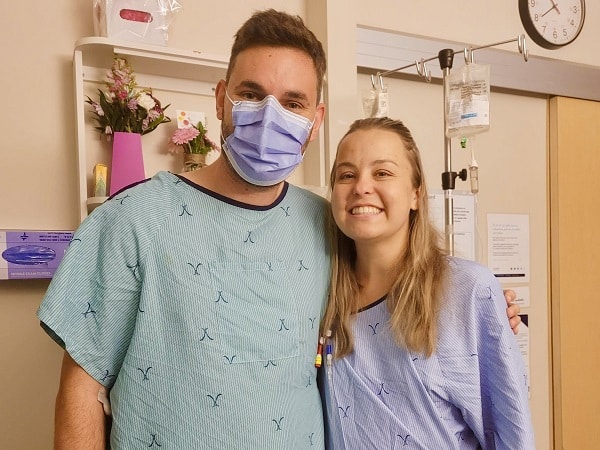
When Brittany Smith first found out she needed a kidney transplant, her family didn’t hesitate to find out if they could be a donor.
It was a “terrifying process,” made heavier as family members were slowly denied as possible donors. Unbeknownst to her, Smith’s brother-in-law, Craig Thompson, continued to make progress towards becoming a donor.
“He kept it quiet because he didn’t want to get my hopes up,” says Smith, a 32-year-old Port Colborne resident. “From the time he entered our family, he made it a priority to build strong relations with each of us. Craig and I are very close. I consider him a brother.”
Smith started dialysis in March 2022 at the St. Catharines and Welland hospitals after suffering from a major seizure, changing her life overnight.
“When I first started dialysis, I was terrified,” she says. “However, at my first appointment, the team walked me through what the process would look like, all of the equipment, the impact it would have on my body and what to be prepared for. Also, the nurses take the time to get to know you. They know how to lighten the mood and make everything less daunting.”
During this time, Smith temporarily lost her license and moved in with her sister and brother-in-law, who often took her to appointments.
“Craig saw how sick I was and wanted to help in any way he could,” she says. “I was someone who played sports, was active at the gym and just bought a house. His donation gave me the opportunity to return to those things and to continue checking off the things that are still on my bucket list. It gave me my life back.”
The transplant surgery, which took place in September 2022, was a success.
“Organ donation can change a recipients’ life,” says Smith. “I will never forget the generosity of Craig and will not take this second chance at life lightly. I believe this to be true for all recipients.”
Between April 2022 and March 2023, 15 organ donors from the Niagara region saved the lives of 35 people. One donor can save up to eight lives, and an additional 75 lives can be improved through the gift of tissue. Eyes can restore sight; skin can help patients heal from burns; bones can be used for joint replacements; heart valves can help with congenital heart disease; and tendons and ligaments can help recipients walk and run.
However, while 90 per cent of Ontarians say they are in favour of being a donor, only 35 per cent actually register.
Approximately 1,400 people in Ontario are waiting for an organ transplant. According to the Trillium Gift of Life Network, Ontario’s organ and tissue donation agency, someone in the province dies every three days because they didn’t get their transplant in time.
“Registering to become a donor only takes two minutes,” Dr. Hari Vasan, Niagara Health’s Hospital Donation Physician and Medical Director of the Critical Care Response Team. “All you need is an Ontario health card. It’s also extremely important to tell your family what your wishes are.”
Vasan says that everyone is a potential donor, regardless of age or medical condition. Even if one organ is ruled out, other organs can still be accepted. Niagara Health works closely with the Trillium Gift of Life Network to identify potential donors.
On Friday, April 7, Brock University’s Schmon Tower and the City of Welland’s Bridge 13 will be lit up green in support of BeADonor Month. In addition, Niagara Falls will be lit in green from 10 p.m. to 10:15 p.m.
Anyone over the age of 16 is strongly encouraged to discuss their wishes with their families and register to become an organ and tissue donor at BeADonor.ca
Michelle Pressé works in communications at Niagara Health.