

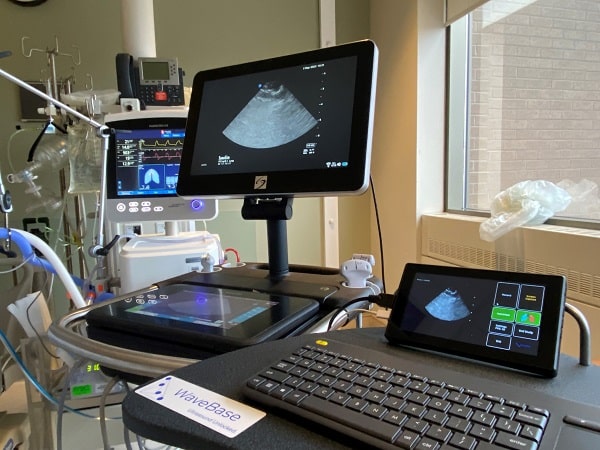
A team at Lawson Health Research Institute are testing a new form of artificial intelligence (AI), paired with portable ultrasound machines, to image and identify lung concerns in real time, right at the beside of critically ill patients.
Approximately 100 critical care patients at London Health Sciences Centre (LHSC) will be part of this study which will test whether an AI model can automatically determine the presence of abnormal lung signals. Past studies have suggested that the AI model is very accurate in reading stored images, but this study will evaluate if it retains accuracy when asked to interpret live images being generated at the beside.
The study is made possible through the use of novel hardware created in Waterloo, Ontario by startup tech company, Wavebase.
“The (WaveBase) device attaches to the ultrasound machine and mirrors the ultrasound image in a second screen,” explains Dr. Robert Arntfield, Lawson researcher and Medical Director of the Critical Care Trauma Centre at LHSC. “The AI model searches the images for patterns in real time and predicts whether it is ‘seeing’ normal or abnormal lung tissue.”
Although bedside lung ultrasounds are commonly used in critical care to detect concerns such as infections, pneumonia or a collapsed lung, the pairing with real time diagnostic AI is a research milestone. It could expand the usage of bedside ultrasounds by enabling those with little or no ultrasound training to use the device.
“Bedside lung ultrasounds in critical care can often have a large impact in identifying life-threatening conditions within minutes,” says Dr. Chintan Dave, Critical Care Medicine Fellow at LHSC and Western University. “We would like to see members of the healthcare team, like critical care nurses or respiratory therapists, be able to use AI to accurately determine the health of the lungs rapidly at the bedside. Employing AI into the clinical workflow, could improve access to immediate diagnoses and treatments.”
In order to be certain that the AI’s predictions are accurate, the phase one study will compare its interpretations to a gold standard experts’ interpretation of the same lung ultrasound scans. Once this accuracy is assured, the team will proceed with a second phase to assess the device with non-expert users and customized settings for more in-depth diagnostics.
“We see a bright future for lung ultrasound imaging with AI within the critical care environment,” adds Dr. Arntfield. “We are trying to write the first chapter of this meaningful AI story here at LHSC and Lawson.”
Lawson Health Research Institute is one of Canada’s top hospital-based research institutes, tackling the most pressing challenges in health care. As the research institute of London Health Sciences Centre and St. Joseph’s Health Care London, our innovation happens where care is delivered. Lawson research teams are at the leading-edge of science with the goal of improving health and the delivery of care for patients. Working in partnership with Western University, our researchers are encouraged to pursue their curiosity, collaborate often and share their discoveries widely. Research conducted through Lawson makes a difference in the lives of patients, families and communities around the world. To learn more, visit www.lawsonresearch.ca.
Celine Zadorsky works in Communications Consultant & External Relations at Lawson Health Research Institute.