

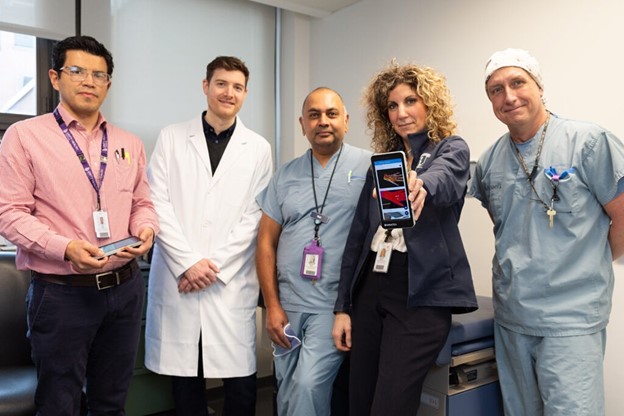
St. Michael’s Hospital has received funding for a device that helps clinicians better treat people with diabetic foot ulcers, who face the risk of limb amputation. Notably, the MIMOSA Pro solution is the result of research that was developed at the Keenan Research Centre for Biomedical Science at Unity Health Toronto.
A team representing the Downtown East Toronto Ontario Health Team’s (DETOHT) Lower Limb Preservation Program successfully applied for Ontario Health and Boehringer Ingelheim Canada Digital Health Care Transformation Funding. The team is led by Vascular Surgeon Dr. Charles de Mestral, Senior Clinical Program Director Desa Hobbs and DETOHT Executive Director Nancy Lin.
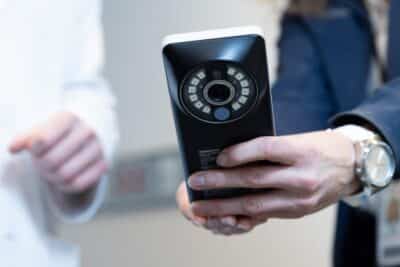
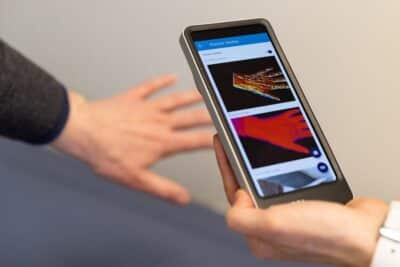
The handheld MIMOSA Pro device uses visible, infrared, and near-infrared light to rapidly capture wound insights at the point-of-care, including: tissue oximetry, temperature, wound measurement, and a digital image. These insights enable clinicians to see beyond what is visible to their naked eye, and better assess a patient’s wound and periwound areas.
“The MIMOSA Pro is essentially a type of wound scanner that gives clinicians information that the human eye – even the expert human eye – can’t see. It’s digital health innovation that will support our team in wound assessment and wound monitoring,”
de Mestral said.
The research behind the MIMOSA Pro was developed at St. Michael’s Hospital by Plastic and Reconstructive Surgeon Dr. Karen Cross and Dr. General Leung, an engineer who led research in the hospital’s MRI department. In 2020, Cross competed at the Angels Den medical competition and won funding to push the project forward.
Since then, the MIMOSA Pro has evolved and has been approved for clinical use both in Canada and the U.S. Cross is now the co-founder of MIMOSA Diagnostics with Leung, who also serves as the company’s chief technology officer.
“To have the MIMOSA Pro come back to St. Michael’s for use in patient care is amazing. I’m very grateful to Dr. de Mestral, and to (Vascular Surgeon) Dr. Elisa Greco who in the early days of MIMOSA had an active role in supporting us and the evolution of this technology,” said Cross.
“We spent a lot of time in their vascular surgery clinic imaging patients. It’s incredible how it’s come around full circle and is now back at St. Michael’s.”
Greco agrees. “Seeing the MIMOSA from conception and early-day trials, to now being in full clinical use in our clinics is incredible. It is truly the ‘bench-to-bedside’ research that Karen and I had always talked about – she was the ‘bench’ research, and I the ‘bedside’ in the clinic, for a collaborative and innovative approach to patient care,” she said.
Revealing what’s invisible to the human eye
The MIMOSA Pro will be used for the care of patients treated in the St. Michael’s vascular surgery clinic as part of the DETOHT’s Lower Limb Prevention Initiative, a community health program that seeks to improve services for patients at risk of or with foot wounds related to diabetes and peripheral artery disease.
Diabetic foot ulcers are open sores or wounds that can develop on the feet of people with diabetes, as a result of nerve damage and poor circulation. Diabetic foot ulcers require intensive treatment usually including a combination of wound cleaning/dressings, medications and surgeries or minimally invasive procedures to improve blood flow or treat severe infection.
De Mestral said that under typical circumstances, clinicians assess a patient’s wound or foot ulcer and come up with a treatment plan. After a few weeks, the patient’s wound is re-assessed to see if the treatment is working or if more aggressive interventions are required.
He believes the MIMOSA Pro can help speed up this process by giving clinicians more certainty about the patient’s risk level and the required treatment.
“This digital health solution gives us extra information and insights that can guide us to more timely interventions, and ultimately prevent leg amputations,” he said.
A fortunate ‘collision’
Cross said it was a fortunate “collision” with Leung many years ago, that laid the foundation for MIMOSA Diagnostics. Over many coffees at a café close to St. Michael’s, the two developed the MIMOSA Pro, resolved challenges and eventually perfected the technology.
“That collision was the most important thing that happened because it connected me with a person who understood the engineering piece and also the clinical piece, because he worked in the clinical environment every day,” Cross said of Leung. “He built the first prototype in his kitchen, and we tested it in my lab. That’s how MIMOSA started.”
She credits the unique research environment at St. Michael’s for bringing her and Leung together, despite their different academic backgrounds, and supporting them throughout the development phase of MIMOSA.
“There is an appetite for entrepreneurial activity at St. Michael’s that is different,” she said. “There’s a focus on translating the science, so it’s not science for the sake of science, but science that’s having a real-world impact.”