

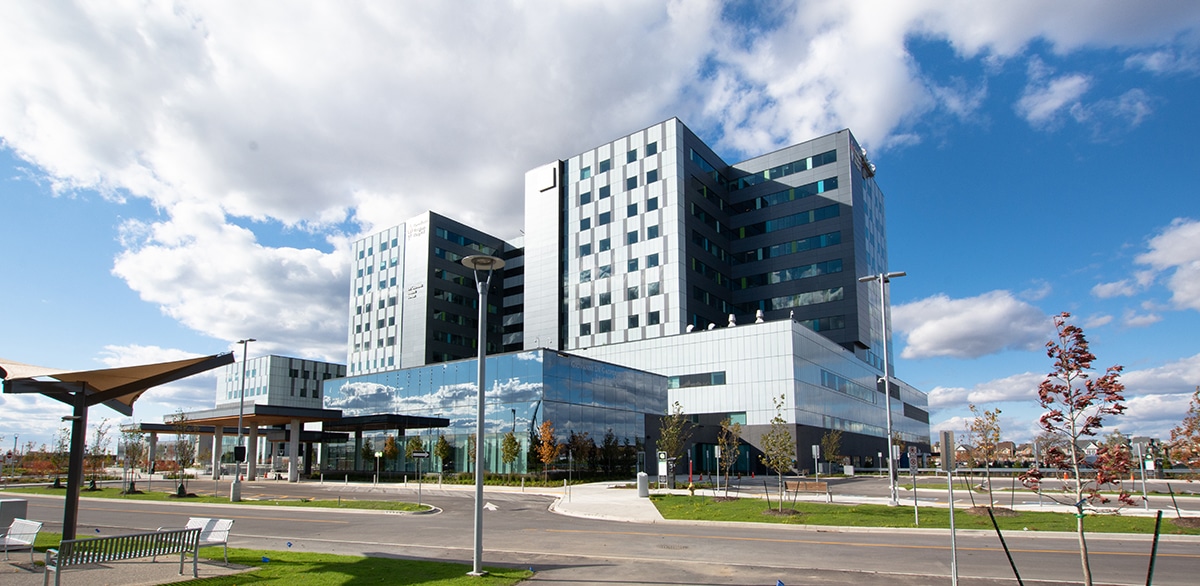
The Ontario government is providing up to $125 million to immediately add over 500 critical care and high intensity medicine beds to hospitals in areas with high rates of COVID-19 transmission. A portion of the funding will also be used to temporarily transition Mackenzie Health’s Cortellucci Vaughan Hospital into a system-wide resource supporting the province’s COVID-19 response when the new hospital is scheduled to open on February 7, 2021. These initiatives will help relieve pressures on nearby hospitals due to rapid increases in hospitalization and ICU occupancy rates.
Details were provided today by Premier Doug Ford and Christine Elliott, Deputy Premier and Minister of Health.
“The Cortellucci Vaughan Hospital is the first newly built hospital in three decades and this net new capacity will be critical until we are in a position to widely administer vaccines across the province,” said Premier Ford. “I want to especially thank Mackenzie Health for stepping up to allow us to temporarily use this new facility to support our COVID-19 response and take pressure off other hospitals in the region. It’s these kinds of innovative partnerships that make a world of difference in our fight against this deadly virus.”
Initially, Mackenzie Health’s Cortellucci Vaughan Hospital will provide a total of 185 beds, including over 35 critical care beds and 150 general medicine beds, which will support patients from other hospitals and alleviate hospital capacity pressures caused by the COVID-19 pandemic. Once COVID-19 capacity pressures have stabilized, the new hospital will provide care and services to patients from across the western York Region as originally planned, including emergency and modern surgical services, and offer advanced diagnostic imaging capabilities, intensive care beds, medicine, birthing, pediatrics and mental health services, as well as the York Region District Stroke Centre.
“When Mackenzie Health opens Cortellucci Vaughan Hospital in February, our exclusive focus will be on creating new capacity for critical and general medicine beds to provide relief for the current surge in critical and acute care volumes brought on by the pandemic. Opening Cortellucci Vaughan Hospital was always intended to be a tangible solution to ending hallway medicine. Although it will be a very different opening than we had anticipated and committed to our staff, physicians and community, we’re prouder than ever to play a significant role in supporting the province’s overstretched health care system as we all work together to fight COVID-19. Operations at Mackenzie Richmond Hill Hospital will continue as they are until the system has stabilized and we are able to fully realize our two-hospital future,” says Altaf Stationwala President and Chief Executive Officer, Mackenzie Health.
Since the onset of the COVID-19 pandemic, Ontario’s government has been working with its hospital partners to create unprecedented capacity and be ready to respond to any scenario. The province invested an additional $2.5 billion in our province’s hospital sector this year, and the new beds announced today at Cortellucci Vaughan Hospital and across the province are in addition to the more than 3,100 beds funded by the province as part of its COVID-19 response.
“Our government is using every tool at our disposal to support our hospitals as they respond to COVID-19,” said Minister Elliott. “This new funding will help to alleviate capacity pressures being faced by hospitals, allowing our health care system to work more seamlessly and effectively to keep Ontarians safe. We will continue to work together with all our hospitals and health care partners to care for those affected by this deadly virus.”
To further support frontline health care workers caring for patients during the pandemic, Ontario has also amended O. Reg 74/20 (Work Redeployment for Certain Health Services Providers) in response to the increasing demands on hospitals and retirement homes. The amended order will allow hospitals to temporarily redeploy health care workers to other hospitals or retirement homes that urgently need additional support. The order was previously amended to allow hospital staff to temporarily work in long-term care homes.
The province continues to work with its hospital partners to further enhance capacity as required.
Quick Facts
- The government is investing $18 billion over the next 10 years in hospital infrastructure projects across Ontario that will lead to $27 billion in capital investments and $175 million in repairs and upgrades to 129 hospitals this year through the Health Infrastructure Renewal Fund.
- Operations at Mackenzie Richmond Hill Hospital will continue as they are while Cortellucci Vaughan Hospital temporarily focuses on supporting the province’s short-term pandemic response. The Emergency Department at Mackenzie Richmond Hill Hospital will remain open to serve the community. The Emergency Department at Cortellucci Vaughan Hospital will not open until the system has stabilized. Program transfers planned for Cortellucci Vaughan Hospital, such as Woman and Child, Inpatient Mental Health and Inpatient Integrated Stroke, will not proceed at this time.
- As Ontario’s first net new hospital in over 30 years, Cortellucci Vaughan Hospital was built to help solve hospital capacity challenges in the Greater Toronto Area and end hallway health care.
- As part of Mackenzie Health, Cortellucci Vaughan Hospital will feature fully integrated smart technology systems and medical devices that have the capability to interact directly with one another to provide real-time information and anticipate the patient’s and the hospital’s needs to enhance the patient experience.
- The latest modelling projects ICU occupancy to be as high as 1,000 beds by early February in the most severe, but realistic scenarios, with deaths expected to double from 50 to 100 deaths per day between now and the end of February.
- Effective Thursday, January 14, 2021 at 12:01 a.m., a stay-at-home order is in effect. Ontarians are required to remain at home except for essential purposes such as food, health care, exercise, or work. Stay home, stay safe, save lives.