
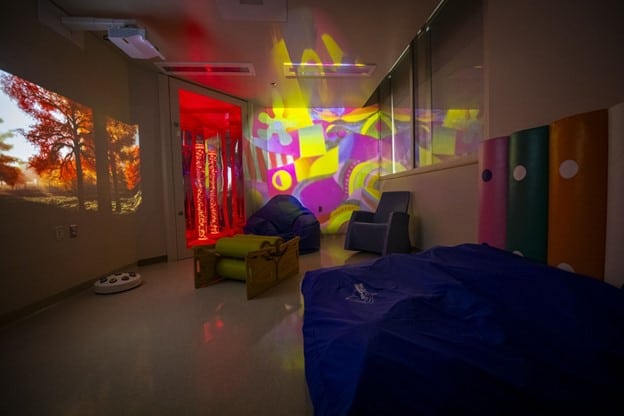

The moment a child steps inside the room, soft lights twinkle across the walls, bubbles rise in a gentle rhythm, and colors swirl like something out of a storybook.
This is the new Snoezelen® multi-sensory room at Kingston Health Sciences Centre (KHSC), a calming escape designed for children and youth receiving care on the mental health unit who may be feeling anxious, overwhelmed, or simply in need of a place to unwind.
Thanks to a generous $150,000 donation through the University Hospitals Kingston Foundation, young patients now have a safe, sensory-rich space where they can explore, relax, and just be kids in the midst of thei1r mental health care journey.
A sanctuary within the hospital
For many children and teens, staying in the hospital can be stressful. New faces, unfamiliar surroundings, and the challenges of treatment can feel intimidating. The Snoezelen room offers something different, a peaceful environment where they can reconnect with a sense of comfort and control.
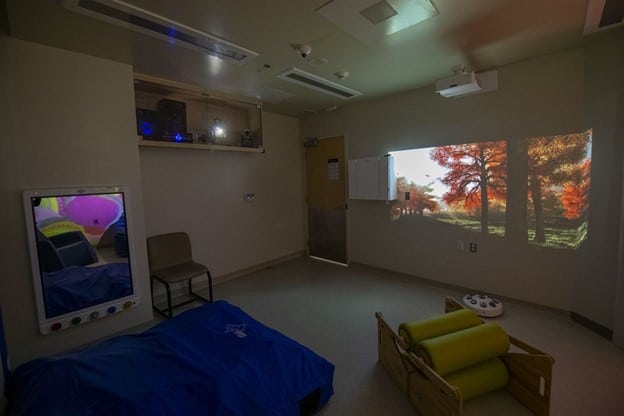
Inside, children can choose what they want to see, hear, or touch. An interactive panel invites them to explore shapes and colors. A bubble tube fills the room with soothing sights, while colourful Bumpas pads provide a vibrating sensation when pressed.
The four cushioned foam rollers of the Double Squeezer allow patients to squeeze and release pressure evenly and consistently, providing a smooth and therapeutic deep pressure relief that can assist with sensory regulation and be beneficial for those with autism.
Immersive projectors help transform the space into whatever feels most calming: a quiet ocean, a sparkling galaxy, or simply a place where the lights move slowly enough to settle anxious minds.
“Kids often come to us feeling overwhelmed,” says Nicholas Axas, KHSC’s program operational director of Mental Health and Addiction Care. “Giving them a place where they can explore through touch, sound, and light — on their own terms — helps reduce stress and makes their hospital experience a little less scary.”
Designed with young patients in mind
The Snoezelen approach is rooted in meeting children exactly where they are. Whether a child needs deep pressure to feel grounded, gentle stimulation to stay engaged, or a quiet corner to settle their thoughts, the room adapts to them.
Mental-health clinicians will use the room to support children with a wide range of needs, including sensory processing challenges, anxiety, autism, and developmental or emotional difficulties. It can be a tool for therapy, or simply a quiet retreat to help a child regroup before heading back to treatment or appointments.
A gift that creates moments of peace
This new room would not be possible without the generosity of a community member. Their support has created a space where young patients can experience moments of calm in the middle of uncertainty.
We are incredibly grateful for this gift,” says Axas. “It’s an invaluable resource that will help hundreds of children feel safer, more comfortable, and more at ease during their hospital stay.”
Looking ahead
The Snoezelen room offers a consistent place of calm for those who need it most. Staff are excited to incorporate the room into both structured therapy sessions and open, child-led exploration.
Most of all, the team hopes the space will become a small sanctuary where young patients can feel brave, supported, and still themselves, even on difficult days.
Christine Maloney works in communications at KHSC.