

Minimally-invasive technique used to bypass blocked arteries, speed recovery
By Sharman Hnatiuk
Fewer patients with coronary artery disease are requiring open heart surgery with the recent introduction of a minimally-invasive technique to bypass severely blocked arteries.
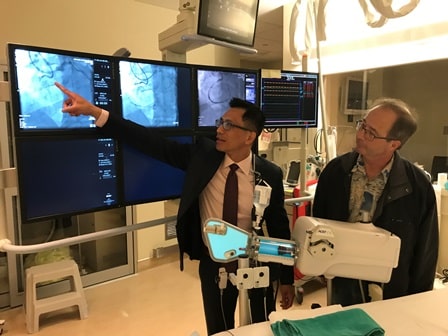
Dr. Minh Vo, a newly recruited interventional cardiologist at the Mazankowski Alberta Heart Institute, has been performing a procedure called antegrade dissection re-entry since his arrival last September. Using a catheter inserted through the thigh or wrist, Dr. Vo inserts a mesh tube called a stent along the exterior artery wall on both sides of a blockage, restoring blood flow. The artery heals and accepts the new channel for blood flow.
Fifty patients have undergone the procedure, and avoided open heart surgery, over the past eight months. Patients typically experience less pain, have reduced likelihood of complications and recover more quickly than those who undergo open heart surgery.
Dr. Vo says the procedure will “change how cardiologists around the world treat patients” with chronic total occlusion (CTO), a complete blockage of a coronary artery caused by a buildup of plaque. One in five patients with coronary artery disease will develop a CTO.
“It’s revolutionary and it is something that can work for most patients with CTO,” says Dr. Vo, adding some patients may not be eligible for the procedure and may require open heart surgery.
Traditional coronary angioplasty – using a balloon or stent to widen the artery – can be used when an artery is partially blocked but is ineffective when an artery is mostly or fully blocked.
Edmonton is the only centre in Alberta, and the fifth in Canada, to offer antegrade dissection re-entry. Studies indicate the use of the antegrade dissection re-entry technique can reduce the risk of future open heart surgery for patients by 80 per cent.
Keith Hutchings, 59, was back at work just one week after undergoing the procedure in February.
“I’m already back exercising,” says the Edmonton man. “I’m so grateful this equipment and the expertise were available in Edmonton.”
Hutchings began experiencing chest pain last year. An angiogram revealed he had two arteries which were 100 per cent blocked and one that was 90 per cent blocked.
Previously, his best option would have been coronary bypass surgery, where surgeons would perform open heart surgery to create a new pathway for blood to flow to the heart, bypassing the blocked area. Instead, Hutchings underwent antegrade dissection re-entry, which involves a two-hour procedure in the cath lab followed by one to two hours in the recovery bay.
“They could only do one artery at a time, but I’m so happy I had the option of two less invasive procedures three months apart rather than having open heart surgery,” says Hutchings.
In January, Dr. Vo became the first in the world to use the TrapLiner, approved by Health Canada that arranges surgical tools in concentric circles inside a catheter. The TrapLiner creates a smaller hole in the artery, which is beneficial for frail, elderly patients who undergo antegrade dissection re-entry.
“This novel equipment allows for a safe and successful procedure in a much smaller hole providing more patient comfort,” says Dr. Vo. “This is a game changer for patients with complete blockages of the coronary artery.”
The Mazankowski Alberta Heart Institute has become one of Canada’s leading heart centres in the prevention and treatment of heart disease and is also the training ground for the cardiac leaders of tomorrow. Dr. Vo will be teaching the antegrade dissection re-entry technique to colleagues and students at the facility, and will continue to teach the technique across Canada, the U.S., and Asia.
“This procedure is available in Edmonton thanks to the work of many people,” says Dr. Vo, “and the teams and leaders within Alberta Health Services, the Mazankowski and the cath lab have been instrumental in this endeavour.”
Such advanced treatment would not be possible without the support of the University Hospital Foundation, whose donors generously funded the purchase of the equipment in the cath lab.
The University Hospital Foundation raises and manages funds to advance patient care, research and health care education at the University of Alberta Hospital, the Mazankowski Alberta Heart Institute and the Kaye Edmonton Clinic.
Alberta Health Services is the provincial health authority responsible for planning and delivering health supports and services for more than four million adults and children living in Alberta. Its mission is to provide a patient-focused, quality health system that is accessible and sustainable for all Albertans.
Sharman Hnatiuk works in communications at Alberta Health Services.