

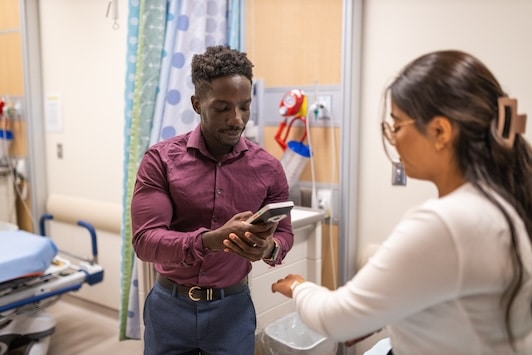
An imaging device developed by an Ontario start-up company is being studied at Hamilton Health Sciences (HHS) to see if it can better identify early signs of pressure injuries, with a focus on people with darker skin pigmentation. This patient population is more difficult to assess with the current, standard tools involving a visual inspection. As a result, pressure injuries may not be identified as early as they could be.
The pocket-sized, handheld device, called the MIMOSA Pro, was developed by MIMOSA Diagnostics Inc., a Toronto company specializing in medical devices that promote inclusive and equitable health care.
The need for such technology was made clear by a review of pressure injury incidents at HHS McMaster Children’s Hospital that showed considerably more pressure injuries in patients with darker skin pigmentation, says Ari Collerman, chief of interprofessional practice at HHS, and the study’s lead.
Early intervention saves lives
A pressure injury, also called a pressure ulcer or bedsore, is damage to skin and tissue under a bony part of the body that has been pressed against a surface, such as a mattress or wheelchair. They happen when patients aren’t able to shift their weight, and the skin starts to break down.
Due to pressure, less blood gets into these areas and over time a wound can occur. It can start as a red area and progress to a very serious wound exposing cartilage or bone. If left untreated, pressure injuries can lead to sepsis, a life-threatening condition caused by an out-of-control response to an infection.
“Preventing hospital-acquired pressure injuries and sepsis are strategic priorities for HHS, as is equity, diversity and inclusion,” says Dr. Ted Scott, vice president of innovation and partnerships for HHS. “We welcome the opportunity to test technology new to Canada that helps improve health equity for our patients.”
Identifying signs
Current practice in hospitals across North America is for health-care providers to visually check for risk of pressure injuries using something called the Braden Scale, which rates a patient’s risk of skin breakdown by how it appears as well as discomfort or pain, exposure to moisture, the patient’s ability to reposition their body, friction against the skin, and nutrition.
The MIMOSA Pro can identify signs below the skin’s surface that aren’t yet visible to the naked eye, capture the images and upload them into the hospital’s secure health records system so they can be tracked over time.
Launching the study
McMaster Children’s Hospital was connected with MIMOSA through its partnership with the Coordinated Accessible National (CAN) Health Network – a national organization working to scale Canadian innovation across Canada.
The CAN Health Network is supporting a project between MCH and MIMOSA that will look at whether the MIMOSA Pro is more effective than the Braden Scale in detecting early signs of pressure injuries, including in darker skin pigmentation. The project is set to launch in June.
During early discussions with MIMOSA leadership, the technology wasn’t yet available in Canada. “It hadn’t been Health Canada approved, although it was a Canadian innovation,” says Collerman, adding that HHS worked with the vendor to support the application to, and approval by, Health Canada.
“It takes a large team from various areas of the hospital working together to make this type of study possible.”
HHS teams supporting the study include MCH; quality and performance; skin, wound and ostomy; interprofessional practice; and innovation.
Studying Mimosa Pro’s effectiveness
“If we have positive results, we’ll purchase additional devices and make them part of our routine care for patients who may be at risk,” says Collerman.
The study team is finalizing which hospitals across HHS sites will take part in the study. Ten units from several sites have volunteered, so there’s keen interest in testing this technology, says Collerman.
Patients will be tested with both the Braden Scale and MIMOSA Pro to see if there’s a difference in early detection. The study team plans to use Epic, the hospital’s state-of-the-art hospital information system, to store and track data, comparing the two tools.
“All patient populations will be included in the study, but we’re especially interested in our patients with darker skin pigmentation,” says Collerman.
By Lise Diebel