

By Erinor Jacob-Levine
Receiving a positive COVID-19 test result can be both scary and overwhelming due to the potentially serious and largely unknown consequences of the virus. To better support those who have been diagnosed with COVID-19, six physicians at London Health Sciences Centre (LHSC) have developed a new care pathway to identify, triage, monitor, and manage the potential complications of the disease through a new virtual clinic. The LHSC Urgent COVID-19 Care Clinic is caring for patients referred from the Middlesex-London Health Unit, Emergency Department, and family practitioners, as well as patients discharged from inpatient services.
“We want to see all patients in London with COVID-19 as soon as possible after their diagnosis. This will help us identify those at high risk for complications so that we can arrange home monitoring of oxygen levels,” explains Dr. Erin Spicer, a general internist at LHSC and one of the creators of the clinic.
Dr. Spicer describes how research is showing that patients with COVID-19 may not seek care until it’s too late because the symptoms of low oxygen levels may not be noticeable early in this disease. “These patients can experience hypoxia – low oxygen levels – without the typical warning signs such as shortness of breath,” Dr. Spicer says, “by the time they do exhibit signs and get help, they can be at a critical stage in the disease.”
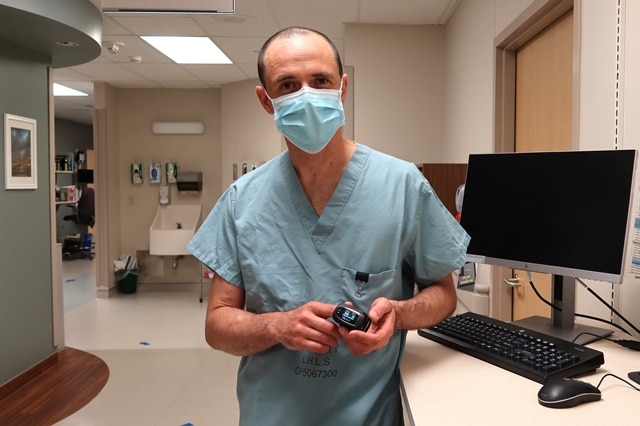
The clinic is working with patients to prevent this deterioration by giving them an algorithm they can use to self-monitor their health with physician support. If a patient is over the age of 40 or has a pre-existing chronic condition that puts them in a higher risk category for hypoxia, they are sent a pulse oximeter immediately.
The following day during their virtual consult, the physician explains how to monitor symptoms using an algorithm, how to use the pulse oximeter and when to call the clinic, the on-call physician, or an ambulance.
“We’ve created a monitoring algorithm for the patient to follow which helps them determine when they need to contact the clinic,” explains Dr. Devlin, an infectious disease specialist and co-creator of the clinic. Patients can reach the clinic either by phone, email or more urgently through the pager system which is answered by the clinic’s on-call physician.
There is also an intake process for patients from the clinic who need to be admitted. Patients are admitted directly to their designated bed with the appropriate personal protective equipment when they arrive at the hospital thereby avoiding the Emergency Department and decreasing the risk of exposure to healthcare providers and other patients.
The clinic concept was developed by Drs. Marko Mrkobrada, Michael Nicholson, Erin Spicer and Megan Devlin. They, along with Drs. Inderdeep Dhaliwal and Jaclyn Ernst, plan to follow patients over the next year, both virtually and in person, to ensure they have the support they need. Based on patients’ needs, the clinic has developed subspecialists referral pathways to Psychology, Otolaryngology, Cardiology, and Neurology. Future collaborations are planned with Physiotherapy and dieticians.
The virtual clinic is overseen by the Department of Medicine and will run as a continuous quality improvement initiative. It will undergo multiple plan-do-study-act (PDSA) cycles to ensure the process is as efficient and easy as possible for patients, while still producing meaningful data needed by the physician team to inform an appropriate care response.
“We are excited to collaborate with our physicians and the Middlesex-London Health Unit to provide support and care to this patient population,” says Ann Turcotte, Director, Department of Medicine at University Hospital, LHSC. “We are very happy our virtual care program is helping COVID-19 patients during this pandemic.” Turcotte is responsible for overseeing the administrative implementation and on-going progress of this initiative.
In just over two months, the clinic has seen 82 new patients. Of those, 63 per cent meet the criteria for requiring monitoring of their oxygen levels at home. The clinic plans to expand capacity over the next several months in preparation for a potential second wave. This quality initiative is helping ensure patients get the care they need, when and where they need it.
Erinor Jacob-Levine is a Communications Consultant at London Health Sciences Centre.