

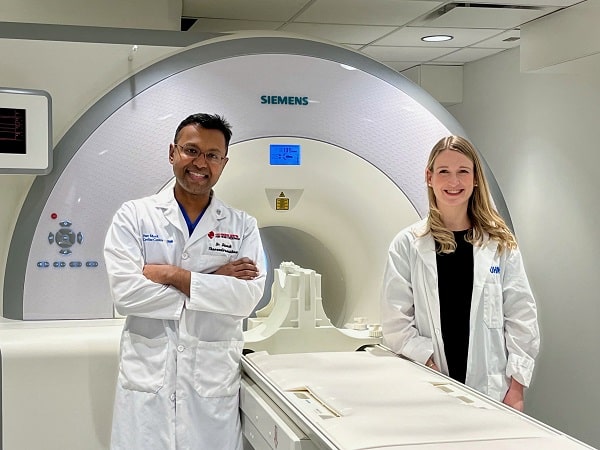
In a world-first, UHN researchers used PET/MRI scans to measure heart injury in recovered COVID-19 patients, revealing that a small percentage had inflammation in their heart after infection.
This multi-disciplinary study drew on expertise from across UHN including the Peter Munk Cardiac Centre, the Joint Department of Medical Imaging (JDMI), and the Department of Laboratory Medicine and Pathology.
An MRI (magnetic resonance imaging) is a non-invasive medical imaging technique that creates a detailed image of organs and tissue within the body. A PET/MRI provides further detail by combining the MRI information with positron emission tomography (PET), a separate non-invasive medical imaging technique that measures changes in heart metabolism and other activities such as blood flow, inflammation, and more.
Heart damage and COVID-19
“One of the things we learned early on in the pandemic is that patients who sustained heart damage from severe COVID [those who required hospitalization] did quite poorly,” says Dr. Dinesh Thavendiranathan, co-principal investigator of the study published in the Journal of the American Medical Association Cardiology, and cardiologist at the Peter Munk Cardiac Centre, UHN.
“However, because over 90 per cent of individuals with COVID are not hospitalized, we started to wonder about undetected heart injury among these patients, especially given the common report of symptoms that may be related to the heart, such as palpitations.”
Previous studies used cardiac MRI to identify heart damage in patients with mild COVID (those who did not require hospital admission), but with inconsistent results. To provide clarity, UHN researchers opted for a more sensitive test.
Using a PET/MRI, which tracks changes in glucose use by the heart to measure inflammation, researchers assessed a group of patients recently recovered from COVID.
Heart inflammation caused by COVID gets better on its own
The study included 47 patients who tested positive for COVID-19 between November 2020 and June 2021. The PET/MRI detected inflammation of the heart in eight patients.
Patients with inflammation on PET also had worse markers of heart function and damage on MRI, as well as higher blood inflammatory markers, compared to those without. Dr. Kathryn Howe, vascular surgeon at UHN, and Dr. Jason Fish, senior scientist at TGHRI, led the blood biomarker analysis along with PhD candidate Dakota Gustafson.
“There has been some contention about the range of abnormalities after COVID reported in prior MRI studies,” explains Dr. Kate Hanneman, co-principal investigator of the study, and cardiac radiologist, JDMI, UHN.
“Since there’s no imaging before COVID for comparison, it is possible that some of the abnormalities reported were already there before the patient got COVID. Our study gives contemporary information in addition to the MRI that suggests the heart injury that we’re seeing is, in fact, caused by COVID.”
When patients returned for a second PET/MRI two months after the first, test results revealed the inflammation got better on its own, without treatment, further supporting the suggestion that the heart injury was caused by COVID. The improvement in inflammation on PET was also accompanied by a corresponding improvement in MRI and blood test results.
This spontaneous improvement is good news. But inflammation can result in damage to the heart which may manifest in the long term, warns Dr. Hanneman.
“It’s important to remember that we don’t know the long-term consequences of heart injury after COVID, or the impact of variants like Omicron,” she says.
Looking forward
Long-term follow-up is the crux of further research, says Dr. Hanneman.
“We’ve started following up with patients who have reached the one-year mark, and will continue to do so,” she says. “Eventually, we would like to know more about the long-term cardiovascular disease risk.”
For now, the data sends a clear message.
“What does all this mean? It means even if you had mild COVID, there is a small risk of potential injury to your heart,” says Dr. Thavendiranathan.
“Given that we don’t understand the heart consequences of more recent variants, the best protection is to remain safe and minimize the chance of getting infected.”
This article was submitted by UHN news.