

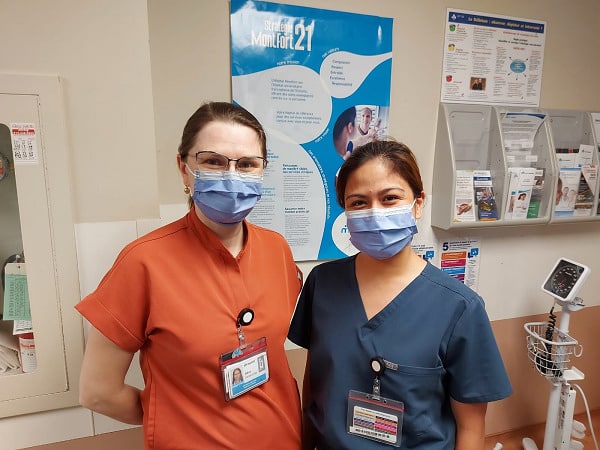
A special connection between a nursing practice supervised candidate and her mentor
By Judith Makana
Here’s a wonderful story of the connection formed between a nurse trained abroad, Alina, who was eager to share her experience with newcomers as a mentor, and another nurse also trained abroad, June, who was dreaming of the day when the recognition process would become more fluid.
By now, we’re all aware of the many challenges the healthcare sector is facing in terms of resources; skilled professionals are rare, and the needs are significant – and Hôpital Montfort, Ontario’s Francophone academic hospital, isn’t spared.
Recently, the College of Nurses of Ontario launched the Supervised Practice Experience Partnership program.
At Montfort, this was something we wanted to explore, but our needs regarding bilingualism made it so that only a few students were selected on the ten or so pairings identified by the Ministry of Health.
(Since then, Montfort has launched an immersion program, meaning people who speak only French or only English can be considered for some roles without conforming to our language requirements when they’re hired. For more information, visit montfort.ca/en/immersion.)
I wanted to share with you the first ever experience we had with the Supervised Practice Experience Partnership program at Montfort.
June arrived in Canada with her family four years ago. She then lived in Montreal and worked in a field more or less related to active healthcare, but her heart was still with her former profession, the one that she was practicing in her home country : in the Philippines, June was a nurse.
She jumped on the opportunity offered by Montfort to join a supervised practice program, knowing she could be a nurse once again.
The gift of giving
What June didn’t know back when she joined the program was that five or six years ago, Alina, who received her nursing degree in France, went through a very similar process, which took a lot of tenacity and resilience on her part. Alina knew exactly what June was facing and the emotions going through her.
They met at Montfort, and the rest is history.
“Alina wasn’t just my mentor, she was also my French teacher”, says June, laughing.
“She learned quicker than I thought”, remembers Alina, “she really surprised me!”
“I know my capabilities and the limitations related to my program, so I didn’t hesitate to ask Alina and the entire team for help”, explains June.
“I’m really happy I got to contribute to her learning”, adds Alina, who says she is willing to mentor more candidates through the program. “It’s a pleasure for me. I was in their shoes a few years ago, so I understand what it all means for them.”
“This experience helped me regain my confidence and understand my responsibilities as a nurse in a care unit at the hospital”, says June. “It’s different than where I’m from. I was able to familiarize myself with the Canadian healthcare system.”
“Now, I’m trying to get her to come back and work with my team”, adds Alina, laughing. “She’d be a great candidate if she ever decides to come and work at Montfort. I’m really thankful that I got to take June under my wing. It was a pleasure to teach her how we work in unit 4A.”
A story that ends well
A few weeks ago, we received a message from June, saying she had just gotten an email from the College, telling her she could sign up and thanking us.
As we like to say, once a nurse, always a nurse. June wanted to be a nurse again, especially in the current circumstances. She was able to find her way back to the profession with the help of Alina.
Thank you, Alina, for being the great mentor – in nursing and in French!
Montfort is proud to have contributed to the integration of a nurse in the healthcare system.
Judith Makana is a Professional Practice Advisor at Hôpital Montfort.