

For 20 years, Canadian Surgical Technologies and Advanced Robotics (CSTAR) at London Health Sciences Centre (LHSC) has driven innovation in research, simulation and training the health care providers of today and tomorrow.
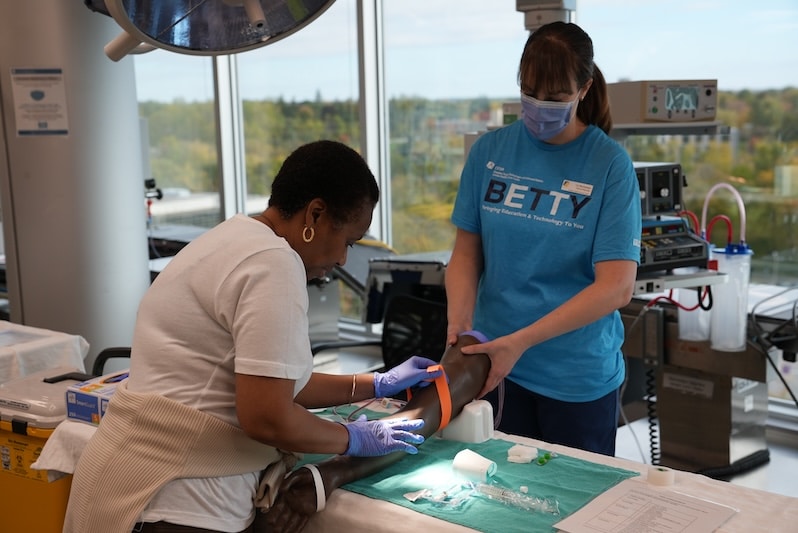
Bringing Education and Technology to You, a mobile simulation training program also known as Project BETTY, is the latest innovative educational program developed through CSTAR.
Project BETTY’s goal is to bring simulation training directly to clinical areas to make skills training more accessible to hospital staff. Instead of booking time off and rearranging schedules to attend off-site training, frontline workers can participate in the training without leaving their unit.
The 15-30 minute-training sessions are focused on developing hands-on skills to address patient safety challenges such as transfers and mobility, catheterization and the recognition of a deteriorating patient.
“We’ve hired many new nurses in the past few years, and because of COVID-19, we had to switch from in-person training to virtual training,” said Stephanie Ayres, Director of Education at LHSC. “The focus of Project BETTY is to provide more of those hands-on training experiences that are so important.”
The training has not only been helpful for newer hires; it has also created opportunities for experienced staff to build on their skillsets and incorporate evolving best practices.
“Best practice standards change all the time,” said Liz McGowan, a clinical educator and one of Project BETTY’s lead instructors. “Having hands-on practice is invaluable as opposed to simply reading about a new policy or procedure. We can actually be there to guide staff through scenarios
together.”
The training has not only been helpful for newer hires; it has also created opportunities for experienced staff to build on their skillsets and incorporate evolving best practices.
Funding from the Skills Development Fund – an Employment Ontario program funded in part by the Government of Canada and the Government of Ontario – was instrumental in hiring staff and purchasing equipment for Project BETTY. Since its launch in May 2023, the program has trained over 800 staff members, putting it over halfway to reaching its goal of over 1,500 trainees in the first year.
“As hospitals and health care facilities evolve to meet the needs of patients in our modern world, it is great to see training methods for staff evolve as well,” said Rob Flack, MPP for Elgin-Middlesex-London. “The $500,000 investment from the Skills Development Fund Training Stream has given the Canadian Surgical Technologies and Advanced Robotics (CSTAR) team at London Health Sciences Centre an opportunity to lead the way with Project BETTY. Training is more efficient, reaching a greater number of staff members and ultimately, improving care for
patients.”
Clinical educators are often focused primarily on teaching nurses, explained McGowan, but because Project BETTY’s educators operate as a mobile simulation team, they have been able to reach a broader range of staff members and help other members of the interdisciplinary care teams to solidify their roles within the
simulations.
The convenience and effectiveness of the training is leading to expansion with plans underway to create new training modules for wound care and other requested topics. The programming and evaluation methods have also been designed to be shared with other health-care organizations.