
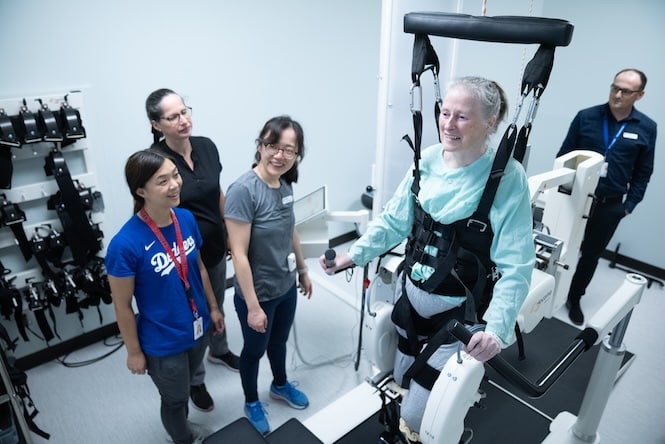

Stroke patient Leanne Mork is learning to walk again with the assistance of a dedicated care team and a Lokomat – a robotic assisted walking system now available to rehab patients at Queen’s Park Care Centre in New Westminster.
The Lokomat helps patients like Leanne regain their balance and mobility after a stroke. It’s helpful for other injuries and neurological disorders such as Multiple Sclerosis.
For the workout, Leanne is fitted into an exoskeleton (harness system) suspended over a treadmill. Robotic sensors help move her legs with the pace and settings constantly monitored by a physiotherapist. The Lokomat provides real-time biofeedback and incorporates game-like exercises during the training session to make it more challenging and fun.
“This technology is a game-changer in rehabilitation, benefiting both our patients and the therapists who are receiving specialized training,” says Saba Hena, Project Leader at Queen’s Park Care Centre. “With more advanced care options, we can provide a higher quality of care and improve patient outcomes.”
The Lokomat and a second device – the ArmeoPower – were donated to the Royal Columbian Hospital Foundation by Vancouver resident Toan Nguyen. “I wanted this technology to be available to more people. After suffering a massive stroke, I saw the benefits, and now I’m walking and working again.”
“We’re incredibly grateful to be able to bring this technology to patients in the Fraser Health region,” says Jeff Norris, President and CEO of Royal Columbian Hospital Foundation. “As the organization responsible for fundraising for Queen’s Park Care Centre, we’re proud that our generous donors continue to step up to provide life-changing care to patients throughout B.C. and support this important facility.”
While the Lokomat focusses on leg movement, the ArmeoPower helps improve upper limb function through functional training. Both devices incorporate virtual reality exercises based on real-life scenarios like fishing to stimulate the brain to learn and retain motor skills.
“It is our hope that this new robotic-assisted technology will help improve our patients’ overall strength, range of motion, and coordination thus, allowing them to get back to everyday life and being able to care for themselves,” says Melanie Mayede, Occupational Therapist, Queen’s Park Care Centre.