

By Annie Atkinson
Within a few years, older Canadians could have their own affordable, mobile, intelligent robots specifically designed to help them stay healthy, independent and living at home.
Dr. Goldie Nejat, director of the Institute for Robotics and Mechatronics at the University of Toronto, who holds the Canada Research Chair in Robots for Society, and Dr. François Michaud, founding director of the Interdisciplinary Institute for Technological Innovation (3IT) at Université de Sherbrooke, are leading a project to create assistive robots that can be used at home, as well as in hospitals, seniors’ residences and long-term care. The project is funded by AGE-WELL, Canada’s Technology and Aging Network.
The robots will help with daily tasks by prompting seniors with cognitive impairment to do everything from brushing their teeth and getting dressed, to preparing and eating meals, doing exercises and remembering to take their medications.
“The objective is to develop robotic assistance to help promote independence, quality of life and assist older people with activities of daily living,” says Dr. Nejat.
“We focus on cognitive impairment, so what we really want the robot to do is prompt the person and remind them of the steps involved in a task. The robot doesn’t pick up the object or do the task, it helps provide encouragement and prompting for the older person to complete the task themselves.”

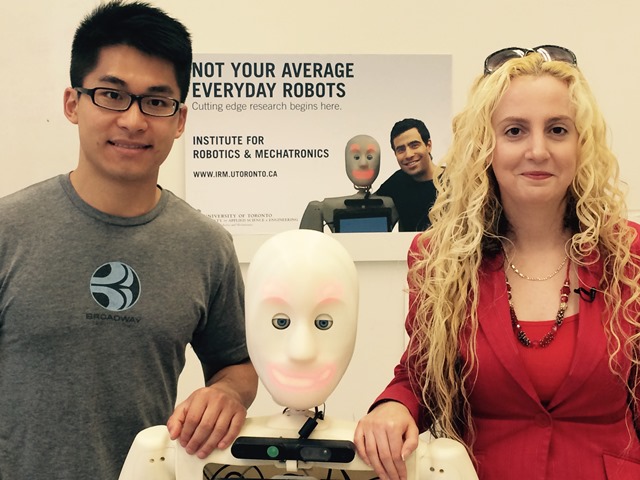
Professor Goldie Nejat AND her team.UNIVERSITY OF TORONTO
ROBOTICS LABORATORY
Professor Goldie Nejat AND her team.
The robots will also be able to assist with “brain training” through memory games that can help the older person retain their cognitive abilities.
Telepresence will make “virtual” medical visits possible—without the older adult leaving the home. “The robot is used as a remote and mobile extension of clinicians and caregivers,” says Dr. Michaud. It will also monitor the person’s well-being and signal for help in an emergency.
Don’t imagine a tin box on wheels that goes beep. These are robots with a human-like face and arms, and a video screen at chest level. They will be capable of social interaction including natural two-way conversation, greeting and pointing gestures, facial expressions, and video and text instructions. The robots will also have the ability to move safely around the home, seniors’ residence and care facility environments.
Dr. Nejat and her team are focusing on the human-robot social interactions and activities of daily living assistance aspects of the project while Dr. Michaud and his group are developing the telepresence, video, mapping and navigation capabilities. The project team also includes researchers at Western University and the Université du Quebec à Montréal.
Partners include CrossWing Inc., Vigilent Telesystems Inc. and Chartwell Retirement Residences.
Members of the research team continue work on a large-scale needs assessment with seniors, using focus groups and questionnaires. Dr. Nejat is using a robot named Casper, created by her and her team, to interact with older adults in seniors’ residences and long-term care. Her group has gathered feedback about social, physical and behavioural features that will make the robots helpful and engaging for users.
The results from all of these studies have been used to inform the creation of an AGE-WELL prototype robot, which is in the final stages of design. The prototype will be unveiled in 2018 for testing with users.
“The users’ needs and wants are part of the process from the very beginning,” says Dr. Nejat, whose earlier work with robots has been featured in Time magazine.
Ultimately, this technology, which will be available on the market in two to five years, will “promote the independence of seniors with cognitive impairment, promote aging in place, minimize social isolation and provide cognitive intervention.”
Mobile social robots will not only help older adults, they will also assist professional and family caregivers with elder care by “minimizing their burden of care and allowing caregivers to focus on high-level interactions and tasks with people,” says Dr. Nejat.
“We’ve had a lot of input from caregivers about how they see the robot helping them. It’s included anything from reminders to reposition a resident in bed to serving as a translator since not all seniors and professional caregivers speak the same language.”
People are looking at robotics as “the next big technology,” adds Dr. Nejat. “I think it will have one of the biggest impacts in our lifetime.”
Jennifer Lee, who lives with her 96-year-old mother-in-law, can instantly see the benefits of a socially-assistive robot. “I think it’s a great idea,” says Lee. “And it’s needed.”
A robot would bring her peace of mind when she is at work and her mother-in-law is at home, she says. Lee particularly likes the idea of someone watching out for problems, such as a fall, and ensuring that the stove is not left on.
Another feature that excites her: virtual medical appointments. Getting to the doctor and sitting in waiting rooms can be a big deal for an elderly person and their family member. Doing it virtually would mean “freedom.”
“I think this is amazing,” Lee says. “I want this for myself in the future.”
Annie Atkinson is a freelance writer. AGE-WELL is a federally funded Network of Centres of Excellence that is harnessing the power of new technologies to benefit older adults and caregivers. The pan-Canadian network brings together researchers, industry, non-profits, government, care providers and end-users to develop solutions for healthy aging. For more information, visit https://agewell-nce.ca/