

By Amanda Stancati
The hospital can be a scary place for many of our young patients, especially when meeting strangers. But being able to see someone’s smiling face provides comfort, reassurance, and a sense of safety.
PPE “can be scary”
With new safety measures in place during the pandemic, masks and other personal protective equipment (PPE) are required to keep patients and staff safe. Staff in the Child Life team at McMaster Children’s Hospital (MCH) recognized that the additional PPE staff were required to wear can make it difficult for providers to connect with their young patients.
“Although we need to wear masks to keep us safe, it can be scary for kids,” says Jennifer Cooke, a child life specialist at MCH.
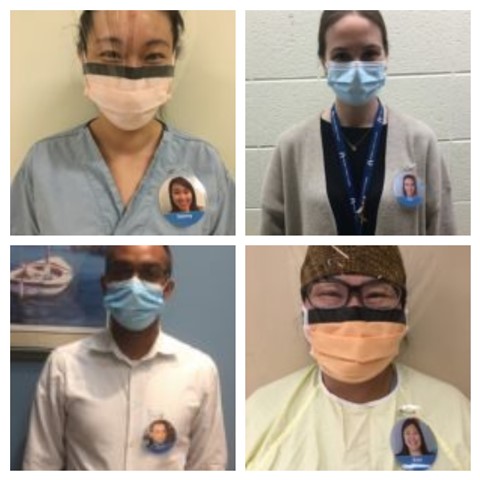
She and a team of child life specialists started the “Behind the Mask” project in mid-May so patients and families could see the smiling faces of their healthcare providers hidden behind additional PPE during the pandemic.
“We wanted to find ways to make what we were needing to wear a bit more pediatric friendly and allow kids to feel that sense of safety,” says Cooke. “When they are looking to somebody’s face they rely on our face for signals to feel safe.”
Friendly faces
They learned of hospitals exploring similar ideas. They created pins to wear on their shirt, lanyard, scrub cap, or headband with their name and photo.
“This way, kids can see our smiles without having to remove our masks,” she says.
The group started making the badges for the entire Child Life team, and as others saw them, the desire grew. Close to 200 nametags have been made so far, and groups such as residents in Emergency Medicine have taken to creating their own pins to broaden the effort.
“It’s our hope that the Behind the Mask nametags can help to enhance patient and staff interactions,” says Cooke. “This creates a positive healthcare experience.”
Amanda Stancati works in communications at Hamilton Health Sciences.