

By James Wysotski
Radiologists in the Medical Imaging Department might get a new assistant in the coming years that never sleeps or leaves the hospital.
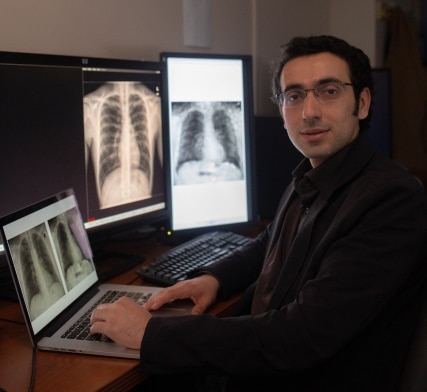
In April 2016, Drs. Tim Dowdell, Joe Barfett and Errol Colak – all radiologists – created the Machine Intelligence in Medicine Lab (MIMLab) to teach computers with artificial intelligence (AI) how to interpret medical images.
Computing systems with AI have been trained to think and learn like human brains. These systems progressively improve their performance on tasks by creating associations between data. The bigger the datasets, the better they learn. Once they’ve learned enough to demonstrate cognitive-like functions such as problem solving, they’re deemed to have AI.
Embracing AI could help radiologists improve quality and reduce errors, notes Barfett. While medical mistakes are not frequent, they happen. Cancers occasionally get missed.
“With these AI tools, it’s very realistic to think that in the next five years no one will ever have a lung nodule accidentally missed on a chest X-ray,” says Dr. Barfett. “AI can make such instances go from rare to exceedingly rare.”
At present, he said there are limitations to what AI can do. For example, it can’t problem-solve to the degree that a human can. After flagging a potential lung nodule on an X-ray, it cannot ask why it’s there and start looking for the cause of the problem. That’s where a radiologist is needed.
However, adopting AI has other advantages. “I suspect that AI can detect cancers that a human cannot because of how well it can sense subtleties on X-rays,” says Dr. Barfett.
Plus, everything gets interpreted in real time, thereby speeding up workflows and reducing wait times for patients. Having computers flag potentially abnormal cases would also be a huge savings to the health-care system since it would allow radiologists to spend their time on more complicated, patient-care oriented problems.
Soon after forming the MIMLab, the three radiologists recruited AI expert Hojjat Salehinejad, a PHD student in the Electrical and Computer Engineering Department of the University of Toronto, who Dr. Barfett said is now the driving force of their research.
Together they have overcome some early stumbling blocks – the team discovered it could not sufficiently train AI algorithms to interpret X-rays using just hospital databases because the datasets were imbalanced. While the databases had numerous examples of common ailments, there were too few of the rarer conditions that also tended to be more life-threatening.
A unique solution was put in place and instead of relying solely on real medical images, the team augmented its database by programming AI algorithms to create computer-generated chest X-rays. Enough images of rare conditions were created, that when combined with the real ones it gave the team exactly what it needed to teach a machine how to spot conditions on a very broad spectrum – including those rare cases that could mean the difference between life and death for a patient.
“By including the computer-generated images, the computers’ ability to accurately interpret X-rays of common diseases improved by 20 per cent. For rarer conditions such as pneumothorax (a collapsed lung), the improvement was about 40 per cent,” says Dr. Barfett.
With each step forward in its AI research the MIMLab helps determine the future of radiology.
“We’re trying to channel our efforts into things that have immediate impact,” explains Dr. Barfett. “We can direct the scientific discourse toward clinical questions that we know could lead to significant improvements for patients in the next five years, even if that means giving away the AI innovations we create.”
James Wysotski is a Communications Advisor at Providence, St. Joseph’s and St. Michaels.