

By Stephen Smith
Maya Angelou the poet once said “I’ve learned that people will forget what you said, people will forget what you did, but people will never forget how you made them feel.”
Maggie’s grandmother was always the life of the party and this was evident in how she chose to die. She waited until all of her children and grandchildren were gathered around and in a moment of laughter that spread throughout the room, she drew her last breath. Tears were shed, but the laughter lent lightness to the situation and served as a reminder that Maggie’s grandmother had died on her own terms, in a way that reflected her life.
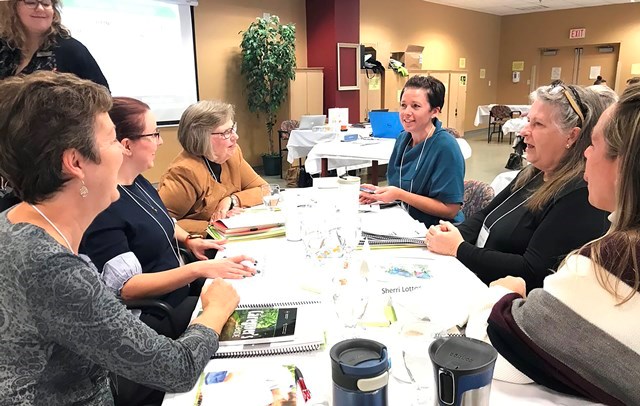
How people perceive end-of-life care is greatly influenced by the language and attitudes that surround the subject. Maggie is one of the instructors who teaches the two-day Communications at the End of Life Train-the-Trainer Workshop available to long-term care (LTC) homes in Ontario. The workshop — tailored to the needs of the LTC environment — prepares participants to strengthen personal support worker’s healthy attitudes towards end-of-life and communication skills in their own LTC homes.
Understanding living, dying, and death within hospice palliative care
Common perceptions of hospice palliative care often revolve around the person being close to death or actively dying. In reality, hospice palliative care extends beyond the scope of dying. It offers services to address physical, psychological, social, spiritual and practical needs, and provides support for loss and bereavement while also preparing for the dying process.
One workshop component tasks participants to reflect upon their feelings and experiences on the difficult topics of death and loss. This exercise helps participants empathize with what a resident or their family or friends might be experiencing. “We often use words and phrases that seem softer and kinder,” a workshop instructor noted. “But in doing so, are we not avoiding talking about the elephant in the room?” Participants are encouraged to use more direct language to help foster clarity and understanding for residents and their visitors. With this in mind, participants are shown exercises that they can teach to personal support workers to identify signs and manifestations of grief. This is essential to understand the internal and external symptoms of grief and mourning.
Fixing issues without solutions
Armed with awareness of self and others, trainers tackle the question of how to help someone who is dying or grieving — the answer can be surprising. One participant said, “We often want to fix things — we want to give answers. But if we take a moment to sit and listen, understand where they are at, we can make the greatest difference.” While the initial response to someone in distress might be to react and help in whatever way possible, those who are grieving sometimes need an empathetic presence — someone who can be there, understand, and listen.
Long-term care professionals have the honour to engage in therapeutic relationships with individuals who are dying and their loved ones. This is often a time of reflection, where complex family dynamics can arise, increasing the need for a high level of clinical and bedside skills.
In order to be fully present for people who are grieving during the dying process and upon death, effective communication skills are critical. It is important to acknowledge that there is grief leading up to, and after death has occurred. Participants take home teaching techniques to strengthen four communication skills to foster therapeutic relationships: listening, paraphrasing, reflecting, and summarizing. One technique that participants found particularly useful was pairing personal support workers to practice these skills and provide constructive feedback to one another. At first glance, communication skills might seem simple, but in a therapeutic relationship, everyone needs practice and support to develop these skills over time to use them effectively.
Why hospice palliative care?
Hospice palliative care is strongly informed by a philosophy, value, and care practice that believes all people matter. As a result, many Ontario long-term homes have embraced the hospice palliative care approach. Being comfortable talking about death and dying is critical for team members working in LTC. These communication skills support residents and their family members along the journey and as one participant stated, “We’re looking at comfort. It’s symptom management, it’s not just about physical pain. We talk about all aspects of pain – spiritual pain, emotional pain.”
Stephen Smith is a Communications Assistant at Bruyère Research Institute.
Communication at End-of-Life Train-the-Trainer Workshops gather long-term care (LTC) team members who train or coach personal support workers. The Ontario Centre for Learning, Research and Innovation in Long-term Care (CLRI) at Bruyère and Algonquin College collaborated to develop the training material. The bilingual facilitators’ guide and four modules are available on the Ontario CLRI website. By focusing on the psychosocial, spiritual, and communication aspects of end-of-life care, these tools complement the various training opportunities available to long-term care home teams, such as Pallium Canada’s LEAP program and courses offered by educational institutions. In the fall of 2018, almost 100 Ontario long-term care homes participated in the training. This work is partially funded by the Ontario Ministry of Health and Long-Term Care, through the Ontario CLRI at Bruyère.