

A humanistic and solution-focused approach
By Elaine Cook
The pandemic has challenged healthcare providers in many ways. It has exposed both weaknesses and strengths of individuals, systems and practices. Greek author and poet Archilochus wisely asserted that, “When we are challenged we do not rise to our expectations, we fall to the level of our practice.” Perhaps now, more than ever, we are being challenged to examine our healthcare practices and to consider how we might rise up in ways that are meaningful to our professional practice and the clients we serve.
The science and solution
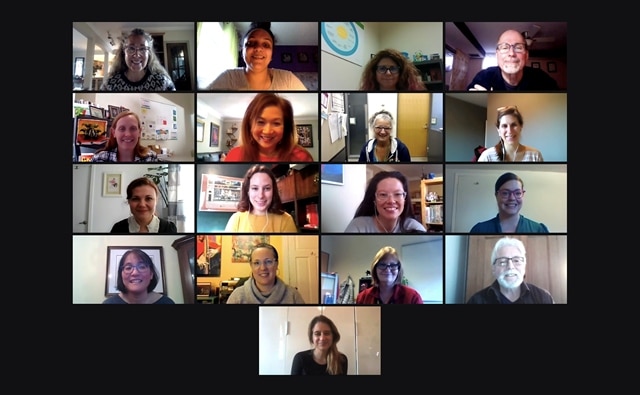
At Holland Bloorview Kids Rehabilitation Hospital, we have been working hard at elevating our individual and organizational healthcare practices. Through our commitment to client- and family-integrated care, we have implemented initiatives that have transformed practice clinically and administratively. One program in particular has impacted every discipline in the hospital, as well as staff, clients and families. December 2020 saw the celebration of the first graduating class of our new, nationally accredited Solution-Focused Health Care Coaching (SFHCC) program. A dozen graduates representing doctors, nurses, clinicians, managers and knowledge translation specialists have completed the intensive 12-month program. They are reconstructing and co-constructing how clients/patients and clinicians experience healthcare, from the inside out.
Neuroscience, neuropsychology, cultural psychology and positive psychology have all buttressed our understanding of how individuals process information and how that information influences thoughts, emotion and behaviour. For example, researchers have evidence that suggests words can change our brains in negative and positive ways. This is good news for our program because our solution-focused approach is considered a strategic and dialogic model of communication. Coaches learn strategies and skills to facilitate conversations that amplify as well as reinforce those positive neural pathways by emphasizing client’s strengths and resources. Clients are engaged as the experts of their own lived experience, while goals and outcomes are co-constructed with clinician-coaches. Dr. Laura Hartman, a researcher and recent graduate, shares: “The evidence- and theory-based approach of the curriculum has guided me beyond a formula for solution-focused conversations towards principles for navigating life situations with a solution-focused approach.”
Feasibly, such an approach not only enhances outcomes for clients, but also healthcare providers. Pre-pandemic, healthcare workers experienced high rates of burnout, which have been exacerbated by the on-going stress associated with the working conditions imposed by COVID-19 protocols. Clinicians and healthcare providers trained as SFHCC have responded to COVID-19 constraints with innovation and resilience. Within weeks of the shutdown, a virtual coaching service for parents and staff was implemented—and is still operating. We are supporting staff transitioning to virtual care through a variety of workshops that facilitate clinicians’ humanistic, solution-focused communication skills.
The support
What makes this 12-month program and training unique is how it is embedded into the daily work schedules and practices of what healthcare providers already do. Learning and placement are seamless and experiential. There are a variety of learning contexts, including formal, informal, self-directed and peer-facilitated. From the very first class, participants learn to contextualize the theory and model to their unique discipline. Amanda Musto, an occupational therapist and recent graduate, describes her experience:
“The peer support and discussion embedded within the SFHCC course has been integral in promoting my comfort and confidence to integrate and embed solution-focused coaching into my practice. Being able to speak with my peers about practical application in different cases and models helped to deepen my understanding and imagination to what solution-focused coaching can look like in a healthcare setting.”
External feedback about the SFHCC program has been resoundingly positive. Keith O’Meara, a social worker, counsellor and instructor with the Solution-Focused Brief Therapy program at O.I.S.E., University of Toronto, described our the program as “impressive,” with well developed, detailed curriculum, learning goals and strategies. Dr. Anne Hunt, assistant professor in the department of occupational science and occupational therapy at the University of Toronto, expressed that the solution-focused fundamental module offered to first year students was a great success and opportunity.
We have the opportunity, as a result of the novel coronavirus, to do something different, to practice healthcare in ways that care for the healthcare provider as well as clients and families. For more information about the new, novel and certified SFHCC program, or the wide variety of workshops and consulting services that can help to transform your organization, please contact Elaine Cook at ecook@hollandbloorview.ca.
Elaine Cook, PhD is the Team Lead, Solution Focused Practice at Holland Bloorview Kids Rehabilitation Hospital.