

HN Summary
• Trailblazing role: Natasha Bloomberg, UHN’s first Emergency Preparedness Specialist, is retiring after 34 years, having reimagined how hospitals prepare for and respond to emergencies.
• Innovative approach: Drawing on her theatre background, she introduced immersive training, built UHN’s Incident Management System, standardized code response kits, and created frameworks for prevention, response, and recovery.
• Enduring legacy: Natasha’s work expanded beyond UHN, helping form Toronto’s first hospital emergency management network and shaping Ontario’s collaborative approach — leaving a lasting culture of readiness, resilience, and innovation.
Natsha Bloomberg, the University Health Network’s (UHN) first Emergency Preparedness Specialist, is retiring. Over more than three decades, she transformed how hospitals prepare for and respond to emergencies, leaving a legacy that extends far beyond UHN’s walls.
Natasha’s journey began in an unexpected place: the theatre. Before entering healthcare, she worked as a director, honing skills in storytelling, character development, casting, and rehearsal. These skills became the unlikely foundation for her career in emergency preparedness, where hospital codes operate like live scripts, and each event requires precise coordination. “Theatre directing taught me how to take a play, cast the characters, direct the actors and tell the story,” she says. “And, because theatre involves all the arts, it taught me to integrate music, lighting, costumes and props.” Natasha would rehearse scene by scene and then “string the pearls,” ensuring every element flowed seamlessly—an approach she later applied to emergency codes, where operators, incident commanders, and response teams must act in perfect synchrony. “A hospital is a living theatre in a way—abounding in complexity and profound human stories,” she notes.
Natasha joined UHN in 1991 as a coordinator in Nursing Education, later moving into administrative support for the head of Neurology at Toronto Western Hospital. When UHN merged with Princess Margaret Hospital, she began working in policy integration and discovered the hospital’s emergency code policies. Unlike static documents, these codes were activated in real time during high-stakes situations. Natasha recognized that while the policies existed, the training, clarity of roles, and coordination were often lacking. She saw an opportunity not just to update procedures, but to reimagine how UHN could prepare for emergencies entirely.
Her work led to the creation of UHN’s dedicated Emergency Preparedness coordinator position—the first of its kind in the area. She built the Incident Management System and championed a framework focused on mitigation, prevention, response, and recovery. Natasha also implemented standardized code response kits on every floor, organized incident debriefings, and ensured lessons from each event informed quality improvement.
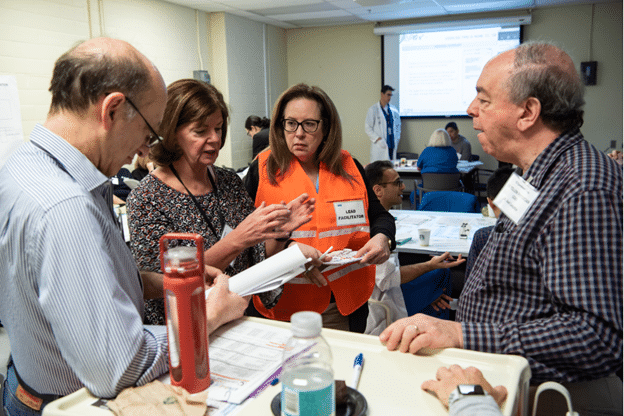
Colleagues remember Natasha’s innovative approach to training, which brought simulations to life. Lisa Colangelo, who joined UHN in 2008, recalls the first time she experienced Natasha’s mock code exercises. “She’d tell you a scenario, and you’d feel like you were in it. Ten years later, I still remember her stories,” Lisa says. One memorable drill involved a simulated chemical spill; staff were so engaged that some forgot it wasn’t a real emergency. “That’s the power of her theatre-based approach—it made us care, it made us act, and we learned without the fear of real consequences,” Lisa recalls.
Natasha’s influence extended far beyond UHN. She formed the first Toronto Hospital Emergency Management Working Group, bringing together representatives from St. Michael’s Hospital, Sinai Health, Sunnybrook Health Sciences, and The Hospital for Sick Children. That group evolved into the Ontario Health Toronto Health Emergency Management Table (HEMT), now composed of more than 60 organizations, creating a collaborative network for sharing best practices and coordinated emergency planning across the province.
Her leadership was particularly critical during the COVID-19 pandemic. Natasha helped establish staff support centres at each UHN site, set up social work-led peer support lines, and served as a PPE coach, guiding clinical teams in safe practices. She co-led the UHN COVID-19 Pandemic After Action Report, documenting lessons learned and helping the organization build resilience for future crises. Colleague Katie Thomson recalls Natasha’s calm under pressure: “Even during the height of the pandemic, Natasha remained composed, methodical, and compassionate. She reminded everyone that preparation is not panic—it’s practice and people.”
Natasha credits her successes to collaboration across hospital teams. “The greatest innovations can come from working with other teams to design exercises, evolve processes and review incidents,” she says. From nurses, physicians, and respiratory therapists to building operators, security staff, and administrators, Natasha integrated diverse expertise to ensure preparedness extended across the entire hospital system.
As she retires, Natasha leaves a legacy that is both practical and cultural. She created systems and protocols that set national standards, but she also shaped a culture of readiness, resilience, and innovation at UHN. Her theatre-inspired approach made the serious work of emergency preparedness engaging and human, reminding staff that in every emergency, coordination, courage, and clarity are essential.
Through her work, Natasha Bloomberg ensured that UHN—and the wider hospital community—is prepared to respond to emergencies not just with binders and policies, but with confidence, creativity, and calm. Her pioneering vision has left a lasting mark, and her influence will continue to guide hospital emergency preparedness for years to come.