Quality patient care starts with information, but access and collaboration between patients and caregivers can be challenging with critical information coming from so many different sources. Today, new technology is emerging to help bridge these gaps to allow for critical information to be accessed, shared and used collaboratively for better communication, reduced administrative workload and improved patient experiences.
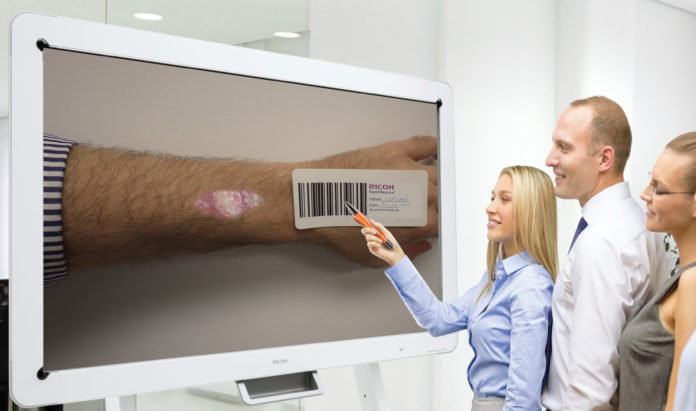
At eHealth 2016 in Vancouver, Ricoh unveiled its new healthcare collaboration workflow including interactive whiteboards, unified communication technology and health integration software. Together, the technologies form a unique end-to-end solution designed to improve image management and enhance related patient and clinical interactions. With the touch of a screen, clinicians can access, mark-up and annotate patient images requiring analysis. They can also collaborate directly on-screen with specialists working remotely or at another facility in real-time to ensure the right people are involved in the assessment. Images and all related information can then be saved and easily attached to the patient record for future access, directly from the interactive whiteboard. The process supports connected care and information mobility initiatives while linking the right people, to the right information, at the right time.
Common uses for the Ricoh collaboration technology include, but are not limited to morbidity and mortality rounds, tumor reviews and treatment rounds and telehealth workflows. It is an ideal fit in scenarios requiring patient-clinician interaction both in person or where co-location is not practical. After a consultation, clinicians can even print directly from the whiteboard to send patients and their families home with the images and information they just reviewed. The solution can also be used for non-clinical purposes such as the coordination of projects across locations, linking “war rooms” for crisis management, or for educational purposes.
To provide timely and effective medical intervention, hospitals require intelligent clinical and back office systems, and technology tailored to its industry’s patient centric requirements. Collaboration and healthcare image management workflows represent just a couple of the many industry-specific use cases that Ricoh has developed that reinforce the organization’s commitment to making information work for healthcare.