
Wearable therapy

Published on

A Toronto research team has created clothing with a special something inside that delivers therapy in a whole new way.

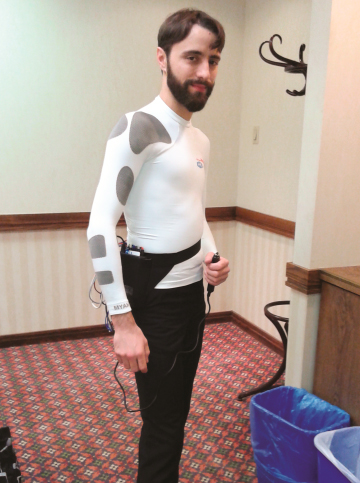
The novel shirt and pants are designed to help reawaken muscles in people with upper or lower limb paralysis caused by stroke or spinal cord injury.

The clothing is embedded with electrodes that deliver functional electrical stimulation (FES)—a therapy that uses low-intensity electrical pulses to generate muscle contractions and improve motor function, such as the ability to stand or grasp a cup.

With AGE-WELL funding, the researchers at Toronto Rehab – University Health Network (UNH) will now test the shirt with people who have upper limb paralysis. The pilot trial is being conducted by project lead Dr. Milos R. Popovic and colleagues in collaboration with industry partner Myant Inc.

“In hospitals, FES therapy is given to patients using an iPad-size electric stimulator,” explains Dr. Popovic. “Garment-based FES is intended for use at home to train and assist people to do daily activities, such as standing, transferring and grasping objects. For older adults whose mobility and participation in society is limited by neurological conditions, the potential benefits are enormous.”

The researchers are also holding focus groups with end users and clinicians with the goal of identifying all challenges in bringing this “e-suit” to market in the future.


Latest articles

Still managing fax referrals manually?

Despite decades of digital transformation initiatives, one technology still dominates referral intake across hospitals...

New research links brain region to linguistic ability

The cerebellum, typically associated with movement, may also play a key role in reading...

Making Clinical Research a Care Option: How Digital Infrastructure is Expanding Access to Clinical Trials in Canada

Across Canada, there is growing recognition that clinical research should not be viewed as...

Privacy-First AI: How Federated Learning Is Transforming Canadian Cancer Research

Imagine training an AI model on patient data from hospitals in Vancouver, Toronto, and...

More like this

Still managing fax referrals manually?

Despite decades of digital transformation initiatives, one technology still dominates referral intake across hospitals...

Making Clinical Research a Care Option: How Digital Infrastructure is Expanding Access to Clinical Trials in Canada

Across Canada, there is growing recognition that clinical research should not be viewed as...

Privacy-First AI: How Federated Learning Is Transforming Canadian Cancer Research

Imagine training an AI model on patient data from hospitals in Vancouver, Toronto, and...

How AI could help or hinder Canada’s health care system

HN Summary • AI could help address Canada’s healthcare staffing crisis by improving efficiency, triage,...

Patient care runs on mobile devices. Is your fleet holding you back?

Dead batteries. Lost devices. Outdated software. Rising security threats.  These are all mobility threats that...

Keeping EDs Open & Reducing Wait Times

Strategic solutions to support emergency departments under strain. Emergency Departments (EDs) are the essential safety...