

By Rebecca Ihilchik
Ben Hartung is no stranger to dementia care. With a mother who’s a nurse and grandparents who lived with dementia, he was inspired by his own life experience to become a geriatric nurse.
As he transitioned from nursing school to the professional world, Hartung noticed many of his peers going through a difficult adjustment period.
“You learn a lot of textbook knowledge in school,” says Hartung, now an advanced practice nurse at Baycrest. “But as a new nurse, you’re faced with another reality of a patient with dementia who could be pacing the halls, yelling, looking for their loved ones. Handling that can be emotionally burdensome.”
What Hartung was picking up on is a phenomenon called ‘reality shock’. The term was coined by theorist Marlene Kramer in 1974 to describe the reaction of new graduate nurses who discover the theoretical work situation they prepared for in school doesn’t match up with the realities of the practical field.
Psychologically adapting to the reality of dementia care can be so difficult for new nurses that they choose to leave geriatrics, or even nursing altogether. This increased turnover can result in worse continuity of care for patients and more money spent by institutions and the healthcare system at large.
Hartung is on a mission to help make that transition for new nurses smoother. That’s why he developed a new dementia communication workshop for nursing students.
Funded by the Centre for Aging + Brain Health Innovation (CABHI), powered by Baycrest, Hartung’s
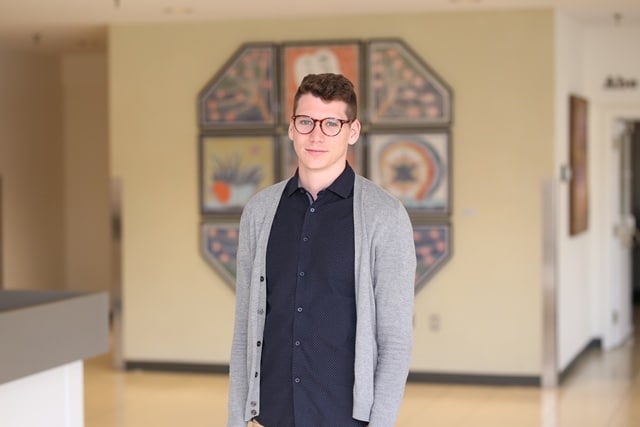
Ben Hartung is an advanced practice nurses at Baycrest who has developed a new dementia communication workshop for nursing students.
The workshop covers common behaviours of dementia patients, frameworks of responding to those behaviours, and simulated case scenarios to implement new knowledge—taking theory and connecting it to practice in a more cohesive way.
“This way, students can have a couple of tools and techniques in their pocket instead of experiencing a whirlwind of not knowing what to do,” Hartung says.
The workshop ran in September 2018 at Baycrest, where Hartung presented to 43 first-year nursing students. He collected survey evaluations from the students before, directly following, and nine weeks after the workshop. The results are being used to measure the workshop’s efficacy.
Hartung’s project was funded through CABHI’s Spark Program, which supports the development and testing of promising early-stage innovations in seniors’ care by point of care staff. He worked on the CABHI application with his supervisor, Baycrest’s Professional Practice Chief of Nursing Calen Freeman.
“Point of care staff are some of the best innovators. We are involved with patient care throughout the spectrum,” Hartung says. “At times it seems daunting and difficult to operationalize any of our great ideas, but a good idea can go very far here at Baycrest. I’ve been really fortunate to work with CABHI, which helped make my project possible.”
On top of the funding, CABHI supported the project by partnering Hartung with Baycrest’s Kunin-Lunenfeld Centre for Applied Research and Evaluation (KL-CARE), which is assisting with analysis and reporting results.
“CABHI’s added a tremendous amount of value,” Hartung says. “They’ve been really supportive.”
In the future Hartung would like to make the workshop accessible not only to more students and staff at Baycrest, but to students across the province or even the country, as an e-learning module.
“The more we can do to advance care for dementia patients, the better,” says Hartung. “And that all goes back to the nurses.”
Learn more at www.cabhi.com.
Rebecca Ihilchik is the Marketing & Communications Specialist at the Centre for Aging + Brain Health Innovation (CABHI).