

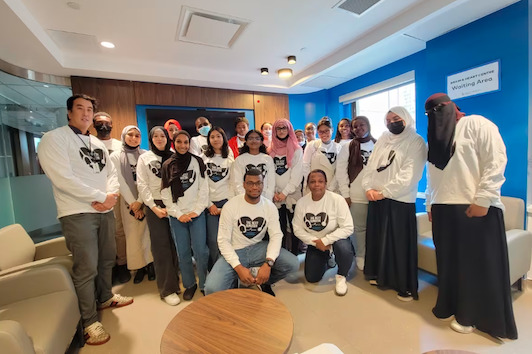

A new pilot program at St. Michael’s Hospital provides mentorship to high school students from communities that are under-represented in the field of cardiac surgery, in the hopes of developing more diversity in the profession.
The Next Surgeon program, launched earlier this year by Unity Health Toronto and Toronto Community Housing, brought about 25 high school students into St. Michael’s to study cardiac surgery over the winter.
Dr. Bobby Yanagawa, head of the Division of Cardiovascular Surgery, founded the program with medical school students Akachukwu Nwakoby and Lina Elfaki as a way to tackle the lack of diversity in the field.
“If you look at the cardiac surgeons across the country, only about 10 per cent are female, and we don’t have much ethnic diversity. Never in the history of this country have we had a Black heart surgeon, and we’ve only had one Indigenous heart surgeon,” said Yanagawa.
“We want the best and brightest to become heart surgeons, and it’s my belief that talent is equally distributed in all people. If we’re only getting talent from one group of people, then we’re missing out on some brilliant future surgeons.”
At first, the three wanted to develop a program that would encourage more diversity at the residency level. They soon realized that if they wanted to be impactful, they had to start outreach earlier, said Yanagawa.
Through a contact at Toronto Community Housing, a group of interested high school students signed up to complete the program, which included mentoring, Q&A’s with prominent Black cardiologists and anesthesiologists, and a skills training, where students completed an online suturing course.
The students also met with Nwakoby and Elfaki, two Black medical school students, to hear about their journeys to medical school, and get tips and tricks about perfecting their university applications.
“Growing up, I was one of the few Black male students in my science classes in both high school and university. I rarely saw Black medical students and Black doctors, let alone Black cardiac surgeons,” Nwakoby said.
“I wanted the students to see that medicine and surgery is a very possible career path for them, despite being from an under-represented group. I also realize that by virtue of my background, I may share unique experiences with some of the students.”
Nwakoby credits his own mentors and a high school co-op placement he completed at Credit Valley Hospital with sparking his desire to become a physician. “My supervisor (at Credit Valley) was the only Black male in my department. He went above and beyond to make me feel integrated in the hospital,” he said.
Feedback and new friendships
Participating students said they enjoyed the program, and particularly valued the chance to speak with mentors who represented their
communities.
“It was just very uplifting to be able to work with mentors who know how I feel and have gone through similar experiences as me,” one Grade 10 student said.
The program, which Yanagawa hopes to grow with the help of sponsors, also allowed participants to form new friendships with like-minded students who are also interested in science.
And as much as the students gained from the program, it was just as rewarding for the physicians and mentors involved.
“Seeing the students ask thoughtful questions and attempt to sew simulated blood vessels re-kindled the spark I have for teaching and mentorship,” said Nwakoby. “It was also very rewarding to hear that some of them became interested in medicine and got accepted to their top university choices.”
Yanagawa agrees. “The kids always give you a lot of energy – energy that comes from their aspirations and dreams. It’s a wonderful feeling to contribute to that,” he said. “Oftentimes I would say that we adults got more satisfaction and joy from it than the students themselves.”
By Marlene Leung