

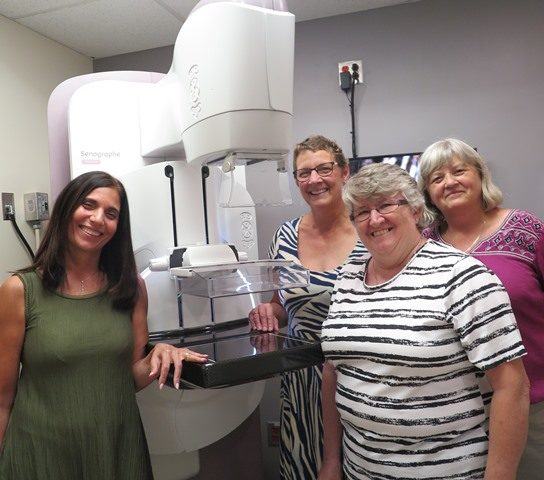

St. Joseph’s Hospital in London is the first in Canada to install the new Senographe Pristina, which allows women to control their own comfort level during a mammogram
By Dahlia Reich
St. Joseph’s Hospital, part of St. Joseph’s Health Care London, has become the first Canadian hospital to install the latest in mammography technology that allows patients to personally control and adjust the rate of compression during the exam.
The Senographe Pristina designed by GE Healthcare is a groundbreaking new breast imaging platform designed by women for women. The mammography machine allows patients to take breast health into their own hands – literally – with a first in-industry, patient-assisted compression tool. Using a remote, patients choose the amount of compression according to their comfort level.
The Pristina mammography unit, now in use at St. Joseph’s, is the first in North America to be equipped with this tool. The feature reduces anxiety and enhances comfort, allowing technologists to focus on precise positioning making the exam easier and faster.
“The new Pristina mammography unit offers a totally different mammography experience for women. It’s a complete departure from the mammogram exam as we know it,” said Dr. Anat Kornecki, Medical Director, Breast Imaging, at St. Joseph’s Breast Care Program. “I believe the innovative design of the Pristina will be more inviting for women and help us improve the screening rates so vital to cancer prevention.”
Other features of the Senographe Pristina and the exam room are also designed for patient comfort:
- All parts of the unit in contact with the patient’s breasts have gentle, rounded corners to help reduce discomfort.
- The system features comfortable armrests that relax the pectoral muscles to simplify positioning, compression and image acquisition. With regular mammograms, women are positioned in a way that projects stress on the handles of the machine, which tenses pectoral muscles and impacts image quality.
- A sensory suite in the exam room allows patients to enjoy a soothing ambiance with music and various scenes on a screen.
“When women are relaxed and comfortable during an exam, there is less movement, which enhances the quality of the images we are able to obtain,” adds Dr. Kornecki. “Better images improve our ability to catch and diagnose breast abnormalities early.”
London area patients, who are the first in Canada to try the unit, are giving the machine rave reviews in comparison to previous mammogram experiences.
“It’s night and day,” says Susan Forde, 65, who has had regular mammogram screening since turning 50. “I didn’t have that sense that I wanted to pull away. It didn’t feel like I was having a mammogram. It felt like nothing. Before I knew it, it was done. Being in control of the compression was fascinating. It’s a game changer.”
Jane Terhaerdt also appreciated the compression control feature. “That was great. It allows you to feel autonomous. When you have control you relax, which helps with the whole process.”
For Betty Powell, being positioned on the machine was much easier than in the past. “You don’t have to be a contortionist. It’s almost like the machine fit around me.”
Research shows that fear of pain is one of the most common reasons women don’t schedule a mammogram.
For the technolgists, the machine is more ergonomically friendly, making it much easier to manoeuvre and to position patients, says Sandra MacFarlane, Technical Coordinator, Mammography, at St. Joseph’s. “This means less strain for technolgists while also getting better images.”
St. Joseph’s Hospital is the primary location for hospital-based breast imaging, diagnostic and surgery services in London, and an affiliate of the Ontario Breast Cancer Screening Program. Approximately 100 patients a day receive breast imaging at St. Joseph’s
In the coming months, St. Joseph’s will receive an additional four Senographe Pristina units, which will replace all of its mammography machines.
Dahlia Reich works in Communications and Public Affairs at St. Joseph’s Health Care London.