
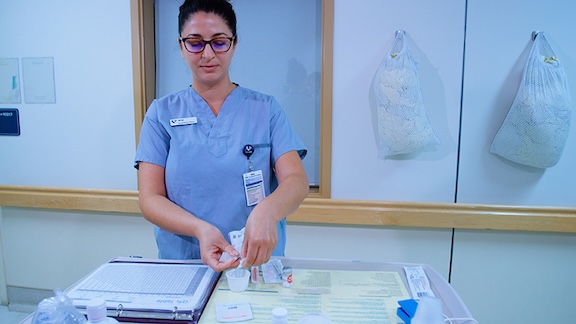

When patients and programs don’t use all the medication that is prescribed, it is often incinerated, creating pharmaceutical waste.
“Within our pharmacy teams, we often discuss the different approaches our hospitals take with recycling oral solid medications, and we are concerned about the impact when recycling doesn’t occur,” says Aaron Tejani, pharmacist, Medical Use Evaluation, Lower Mainland Pharmacy Services. “We wanted to find the best way to improve medication recycling, to prevent waste and reduce our environmental impact.”
“Evaluations done previously at specific hospitals showed that recycling medications was cost-effective,” says Tejani. “But we wanted to see a bigger picture. What would be the total financial impact on all of our sites in the lower mainland, and how much waste could we prevent?”
Tejani and Drummond, along with their pharmacy students, decided to see what they could do to recycle more medication and help the planet. First, they sent a survey to hospital pharmacies in the lower mainland.
“We wanted initial insights to understand who returned medications, how often and why only some unused medications were being returned,” says Tejani.
After collecting the survey, Surrey Memorial Hospital was one of three sites selected for the research study.
“We picked three sites that already had workflows for recycling unused medication and represented the diversity in medication distribution
systems,” adds Tejani.
Next, two research students tracked the time it took to separate, sort and credit unused medication in the electronic pharmacy system and return it to the dispensing bins at the selected sites.
The team calculated how much money sites could save by recycling unused medication. They subtracted labour costs from the return value of recycled medication and used a formula to estimate yearly savings.
The result: Recycling medication in 21 hospitals could divert 461,000 individual doses of capsules or tablets from incineration, saving an estimated $415,000 annually and reducing negative environmental impacts.
“Recycling unused medication will help the environment and make the health care system eco-friendlier and more cost-effective,” says Tejani. “It’s within our reach to work collaboratively to reduce pharmaceutical waste, and the environmental impacts should motivate us.”
The findings of the study were so impressive that a pilot project is planned for two more hospitals in the coming months. Pharmacy students will act as environmental stewards, recycling medication wherever possible and educating staff about how their recycling efforts can help to improve the planet.
By Gurleen Dhessi
Gurleen Dhessi is a consultant in Public Affairs at Fraser Health.