
By Elise Copps
When plans for Hamilton Health Sciences’ Ron Joyce Children’s Health Centre began, designing the building to enhance patient experience was a top priority. The facility provides services across the life span however, but caters primarily to children and youth. It houses programs for mental health, autism spectrum disorder, developmental pediatrics, rehabilitation and prosthetics and orthotics. It was important to care providers that patients and families visiting the site felt welcomed and inspired. The Ron Joyce Children’s Health Centre Art Advisory Committee was formed to develop an art program for the site that would support these goals.
“Research shows that art can reduce stress and create emotional connection,” says Marsha Newby, clinical leader of the Child and Youth Mental Health Program at Ron Joyce and chair of the Art Advisory Committee. “It can offer a positive distraction, and it’s an opportunity to spark discussion. That’s why we felt it was important to include high quality art in the design of our space.”
In consultation with the community and made possible by donor funding through the Hamilton Health Sciences Foundation, the committee curated a collection of more than 40 artworks. The pieces range in scale, medium and style with a focus on works by Hamilton based artists. Roughly half of the pieces in the collection are local, with the remainder from artists in Toronto, Montreal, Vancouver and the United Kingdom.
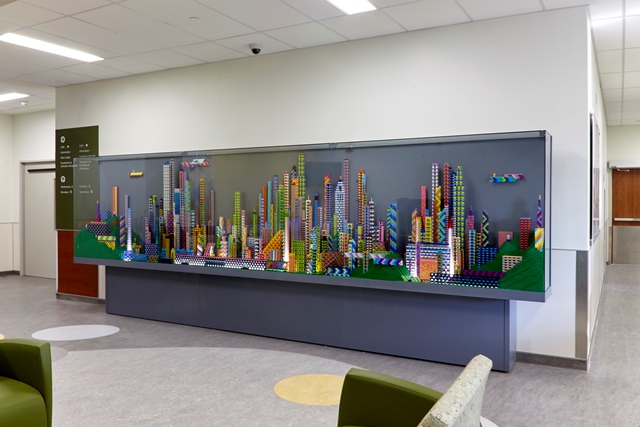
Some large scale works in the collection have become centrepieces of the space. ‘Why? Because’ a hanging installation of planets and stars is suspended from the 4th floor ceiling of the building and is visible from the balcony of each storey. A city scape built of 550,000 LEGO bricks located in the Prosthetics and Orthotics Department has become a popular stop for patients and clinicians at the end of an appointment.
“I often hear from colleagues who offer to show their patients the LEGO city after an appointment,” says Newby. “It gives them something to look forward to, makes the visit memorable, and builds a stronger patient-provider relationship.”
The building opened in 2015, but the Art Advisory Committee’s work continues. The team regularly explores how to make the artwork more accessible to patients and families. Through Hamilton Health Sciences Foundation, they continue to invite donor funding in an effort to source new works to add to the collection, and ultimately hope to research how the artwork affects patient experience.
Elise Copps Is a Public Relations Specialist at Hamilton Health Sciences .