
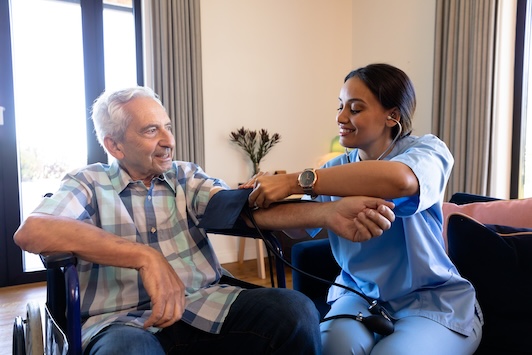

New report from UHN recommends residential high-rise buildings with a high proportion of older adults have a dedicated home care team who can care for multiple clients within the same complex.
The policy paper from UHN’s NORC Innovation Centre says instead of care providers – such as personal support workers (PSWs) – travelling from client to client performing piecemeal work, they be able to work full-time or part-time shifts with minimal travel and provide care of varying duration and frequency based on client needs.
Streamlining services for older adults in one place will “provide home care that’s client-centered, efficient and better for workers,” says the recently released A Home Care Model for Naturally Occurring Retirement Communities in Ontario from UHN’s NORC Innovation Centre.
NORC stands for naturally occurring retirement community. In Toronto, 489 buildings housing approximately 70,000 older adults have been identified as NORCs, each having at least 50 older adults and 30 per cent or more residents over the age of 65.
In the streamlined model set out in the report, staff would be able to see more clients per day without compromising service delivery, yielding
significant productivity gains.
If implemented across all NORCs in Ontario, the analysis finds that this model could provide more than 750,000 hours of additional PSW services worth nearly $26.8 million annually at no additional costs.
“Home care ends up being your community,” says Eugene, a report participant who receives home care.
Eugene hopes for a more streamlined approach to care that fosters a stronger connection between PSWs and residents of NORCs, bringing a deeper sense of “home” back into home care.
The NORC program at UHN leverages the naturally occurring densities of older adults in these buildings to provide place-based services and often integrates health, social and physical supports directly within the community to make it easier for people to age in place.
In 2022-23, PSWs delivered nearly 3.5 million hours of home care services in Ontario’s NORCs, valued at more than $120 million. UHNs NIC analysis found that approximately 85 per cent of NORCs are receiving PSW services from two or more home care agencies.
“It’s no surprise that our community care providers are experiencing burnout,” says Melissa Chang, Director of Operations and Sustainability at UHN’s NORC Innovation Centre. “They can’t continue to be spreading themselves this thin and we are seeing people leave the industry because of the stress.”
A NORC-based home care model would involve assigning a lead home care agency for each NORC building with a high enough clientele. In cases of buildings with fewer home care clients, several NORC buildings in close proximity could be grouped together under the responsibility of a single, lead agency.
A single responsible agency can solve some of the issues raised by older adults who use publicly-funded home care, the report says. Care coordination under this model could be done much more efficiently, directly through the lead agency.
With clear accountability and a funding model that allows for flexibility, assessing any new home care needs, scheduling home care staff and coordinating each client’s care could all be done closer to home, at the level of the NORC, it says.
‘We owe it to our seniors’
This means care decisions would be made by someone who knows each client and their needs, and communication between home care agencies and users are streamlined, which can help develop trust and more consistent service.
A lead agency also allows for home care to be more easily integrated with the rest of the local health care system such as through Ontario Health teams.
The report from UHN follows adoption of a NORC motion at Toronto City Council last fall.
The motion urged both the federal and provincial governments to explore working with UHN’s NORC Innovation Centre to build greater system capacity for innovation, research, and knowledge of targeting the large number of apartment, condo, and co-op buildings that over time, have become home to a high-density of older adults.