HomeCurrent Print IssueUnleashing natural killer cells against cancer

Unleashing natural killer cells against cancer

Published on

Scientists have developed a strategy to boost the cancer-fighting power of natural killer (NK) cells, part of the immune system’s first line of defence. NK cells can detect and destroy cancer cells, but tumours often create a protective barrier that blocks them, allowing cancer to grow.

Researchers at McGill University’s Rosalind & Morris Goodman Cancer Institute, in collaboration with the Research Institute of the McGill University Health Centre, found that suppressing two specific proteins helps NK cells overcome this blockage, turning them into more potent cancer killers.

In preclinical experiments, the approach effectively killed human cancer cells across several hard-to-treat tumour types – including leukemia, glioblastoma, kidney cancer and triple-negative breast cancer – and significantly slowed tumour growth in animal models.

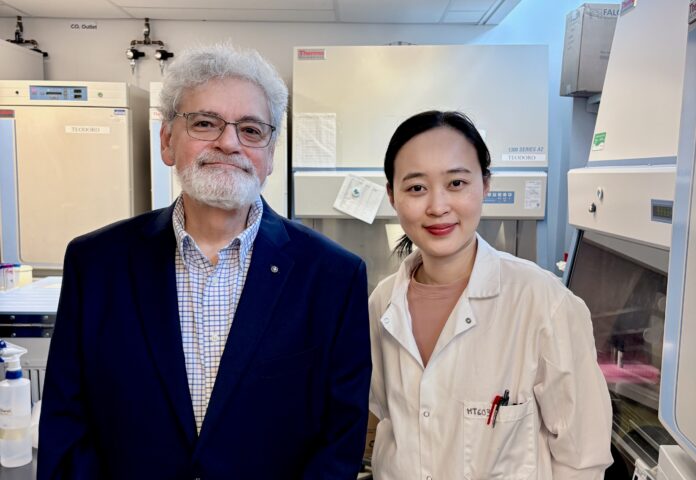
“This approach is particularly promising for patients who currently have very few options, when standard treatments have failed,” said senior author Michel L. Tremblay, Distinguished James McGill Professor in McGill’s Department of Biochemistry and researcher at the Rosalind & Morris Goodman Cancer Institute.

A safer, scalable approach

Genetic editing, commonly used in cancer immunotherapies, permanently alters cells, increasing the risk of unintended side effects. The new approach instead uses small-molecule drugs to temporarily boost NK cell activity without making permanent changes that are harder to control.

Researchers say the treatment strategy could also overcome practical barriers that have limited the widespread use of cell-based therapies.

NK cells from umbilical cord blood donations, isolated at the Cellular Therapy Laboratory led by Pierre Laneuville and Linda Peltier at the Research Institute of McGill University Health Centre, were cultured and banked for the treatment of multiple patients. Unlike many current immunotherapies, which must be custom-built from each patient’s own cells, a process that can take weeks, these NK cells can be ready to use immediately.

“This approach will make immunotherapy at McGill University Health Centre faster, safer and more affordable,” added Chu-Han Feng, a research scientist at the Rosalind & Morris Goodman Cancer Institute. “It avoids the complex process of customizing cells and uses readily available drugs to reversibly enhance NK cells’ anti-tumour activities”.

Acute myeloid leukemia, an aggressive blood cancer, is among the first cancers the team hopes to target in future clinical trials, currently awaiting funding and regulatory approval.


Latest articles

New approach opens door to better-targeted treatments and faster drug discovery for complex diseases

McGill researchers have developed an AI tool called SIDISH that identifies high-risk cancer cells driving aggressive disease, enabling more precise and targeted treatment strategies. By linking single-cell data with patient outcomes, the tool can predict disease progression and simulate responses to potential drug targets, helping accelerate drug discovery and repurposing. While still in development, SIDISH shows promise for advancing personalized cancer care and improving outcomes across multiple tumour types.

Canadian Cancer Society urges lowering colorectal cancer screening age to 45

The Canadian Cancer Society is urging provinces to lower the colorectal cancer screening age from 50 to 45, citing rising rates among younger adults and evidence that earlier screening could prevent over 15,000 cases and 6,100 deaths. Younger patients are more often diagnosed at advanced stages, making early detection critical. Expanding access to simple screening tools like FIT tests could significantly improve outcomes and save lives.

Doctors report false health information, lack of health data sharing put patient care at risk

A new CMA survey reveals major risks to patient care in Canada, with 99% of physicians reporting that disconnected health systems limit access to critical patient information and nearly half witnessing serious adverse outcomes as a result. At the same time, 97% of doctors say they have intervened to address harm caused by false or misleading online health information, including AI-generated advice. The findings highlight the urgent need for integrated digital health systems and stronger efforts to promote reliable health information.

RSV hospital admissions for children more than doubled in 2022/23

New Canadian research shows pediatric RSV hospitalizations more than doubled in 2022/23 compared to pre-pandemic levels, with significant increases across all age groups and nearly one-quarter requiring ICU care. Infants under six months remain the most vulnerable, accounting for the majority of severe cases. The surge is linked to disrupted virus exposure during COVID-19, highlighting the importance of new prevention strategies, including maternal vaccination and infant immunoprophylaxis.

More like this

New approach opens door to better-targeted treatments and faster drug discovery for complex diseases

McGill researchers have developed an AI tool called SIDISH that identifies high-risk cancer cells driving aggressive disease, enabling more precise and targeted treatment strategies. By linking single-cell data with patient outcomes, the tool can predict disease progression and simulate responses to potential drug targets, helping accelerate drug discovery and repurposing. While still in development, SIDISH shows promise for advancing personalized cancer care and improving outcomes across multiple tumour types.

Canadian Cancer Society urges lowering colorectal cancer screening age to 45

The Canadian Cancer Society is urging provinces to lower the colorectal cancer screening age from 50 to 45, citing rising rates among younger adults and evidence that earlier screening could prevent over 15,000 cases and 6,100 deaths. Younger patients are more often diagnosed at advanced stages, making early detection critical. Expanding access to simple screening tools like FIT tests could significantly improve outcomes and save lives.

Doctors report false health information, lack of health data sharing put patient care at risk

A new CMA survey reveals major risks to patient care in Canada, with 99% of physicians reporting that disconnected health systems limit access to critical patient information and nearly half witnessing serious adverse outcomes as a result. At the same time, 97% of doctors say they have intervened to address harm caused by false or misleading online health information, including AI-generated advice. The findings highlight the urgent need for integrated digital health systems and stronger efforts to promote reliable health information.

RSV hospital admissions for children more than doubled in 2022/23

New Canadian research shows pediatric RSV hospitalizations more than doubled in 2022/23 compared to pre-pandemic levels, with significant increases across all age groups and nearly one-quarter requiring ICU care. Infants under six months remain the most vulnerable, accounting for the majority of severe cases. The surge is linked to disrupted virus exposure during COVID-19, highlighting the importance of new prevention strategies, including maternal vaccination and infant immunoprophylaxis.

Aging in place needs more than good intentions — it needs smart infrastructure

Canada’s rapidly aging population is driving urgent demand for new approaches to elder care. Supportive smart home technology—designed to monitor daily routines, detect health risks, and enable early intervention—offers a scalable solution that supports aging in place, reduces caregiver burden, and helps prevent hospitalizations. As costs rise and workforce shortages persist, experts argue these technologies should be treated as essential infrastructure, requiring clear policy, funding, and equitable access to modernize care and keep older adults safely at home.

Gene mutation in blood-forming cells may improve cancer immunotherapy results

Researchers at UHN’s Princess Margaret Cancer Centre have found that inactivation of the TET2...