
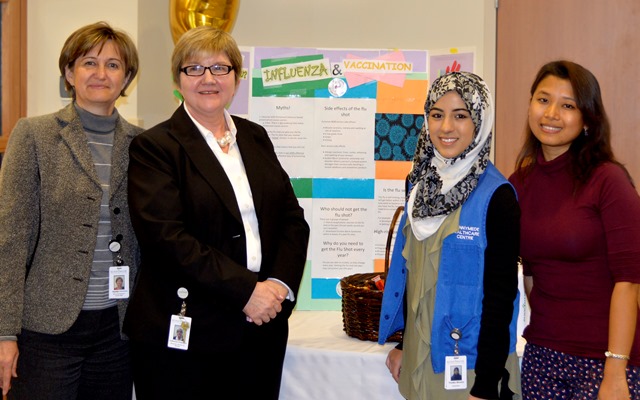
While in hospital, patients expect their health care professionals to get them on the road to recovery. What they do not expect is to be exposed to an infection that could compromise their progress. To help avoid the spread of influenza, #Runnymede Healthcare Centre runs a #flu shot campaign each year that encourages vaccination for all patients, staff and volunteers. The effectiveness of the campaign has distinguished Runnymede as a leader among its peers in the Greater Toronto Area (GTA).
According to the Government of Ontario, the flu vaccine is the best defence against the influenza virus. Despite this, there are challenges to having all healthcare staff take this important precautionary step. One obstacle is the wide availability of misinformation about the vaccine, which leads some to be skeptical about its effectiveness and safety. Another obstacle faced by some healthcare workers is simply not having convenient and timely access to the #flu shot.
These challenges are reflected in the numbers. For the 2014/2015 flu season, Public Health Ontario reported that the median Ontario hospital staff vaccination rate was just 60.5 per cent. However, for the same flu season Runnymede’s staff participation was 80 per cent, an achievement that placed it second among its GTA peer hospitals. At the midpoint of the 2015/2016 flu season, the hospital’s staff vaccination rate was even more impressive, at 86 per cent. How did Runnymede build and sustain such a successful record of participation?
The answer has everything to do with the hospital’s strong culture of patient safety, which inspired the creation of a flu shot campaign committee. Comprised of staff from infection control, human resources and occupational health and safety, the committee’s strategies help clear the obstacles that prevent staff from getting vaccinated. “We don’t reach our immunization goals by simply telling everyone, ‘get your flu shots,’ ” said Runnymede Chief Nursing Executive & Chief Privacy Officer, Raj Sewda. “Instead, our mandate is to create awareness about flu season, provide education about the importance of the flu shot, and then give staff every opportunity to act on their own and get the vaccine.”
MORE: OUTBREAK TASKFORCE SUPPORTS SAFE DISCHARGE FOR PATIENTS
Awareness about Runnymede’s flu shot campaign is generated early each season. By tying its official launch to the hospital’s popular Infection Prevention and Control (IPAC) Week celebrations in October, the campaign has high visibility. The IPAC Week open house that Runnymede hosts features engaging and interactive infection prevention sessions, and the vaccine is made available to everyone who attends.
The weeks that follow build on the momentum of this event. In addition to hospital-wide messaging through email, intranet and bulletin boards, the committee takes a hands-on approach to reaching all staff. “We make regular visits to departments throughout the hospital,” says Catherine Fitzpatrick, associate director of nursing and committee member. “By meeting with staff right where they work and providing trustworthy and evidence-based answers to their questions, we help to shape positive attitudes about the vaccine.”
For the campaign to be successful, education needs to be accompanied by timely and convenient access to the vaccine. In addition to its regular availability in Runnymede’s occupational health department, a mobile flu shot clinic is also dispatched. Staff are notified in advance about when the mobile clinic will be in their area of the hospital.
During the campaign, the occupational health and safety team maintains up-to-date vaccination records by department, and the percentages of staff vaccinations are reviewed regularly by the committee to evaluate the hospital’s progress. Departments with low participation rates are identified, and the committee responds by tailoring additional education and mobile clinic access for staff in these areas. Prize incentives for departments with the highest vaccination rates are positively received and may also be introduced.
At the campaign’s conclusion, the committee looks back on their efforts to review lessons learned. “This is an important part of the process because in the future, we don’t want to be repeating outreach efforts that weren’t effective,” said Fitzpatrick. “By the same token, we also need to recognize which efforts did work well, so that we can incorporate them into next year’s campaign and build on our success.”
Runnymede takes the health of its patients, staff, volunteers and visitors very seriously. The hospital’s firm commitment to its annual flu shot campaigns demonstrates this. “Making educational resources and the vaccine very accessible has a positive impact,” says Sewda. “Informing and reminding our staff and volunteers about how important the flu shot is in maintaining not just their own health, but the health and safety of our patients is a message that really resonates here.”