

By Stacey Palangio
Few industries will feel greater impact from hi-tech innovation than healthcare. Mind-blowing hi-tech gadgets, once only imagined through fictional story telling, are now emerging in ways that are making a significant change in the healthcare landscape. Over the past decade we’ve seen a steady stream of medical innovations moving from research labs into hospitals, clinics and doctor’s offices. Let’s look at some of the hi-tech gizmos we may see as part of our next healthcare experience.
Virtual Vitals: Augmented reality for optimal patient monitoring
Virtual reality technology is approaching mainstream for gamers and entertainment goers but it’s still an awe-inspiring experience for most. Innovators have grabbed hold of the technology and it is now being cleverly applied in industries such as manufacturing, design, communications, and most importantly healthcare.
Take for example the Vitialiti neckband and ear piece created by med-tech company, Cloud DX. The neckband and earpiece worn by a patient can automatically measure their vitals and diagnose conditions like TB and asthma. This gizmo used with HoloLens – augmented reality glasses, (a Microsoft innovation), enables doctors to engage with the digital information from the Vitaliti tool as it automatically appears in the doctor’s field of view. Imagine! With this technology, a doctor can monitor an entire ward of patients by simply looking from bed to bed.
Medical 3D print technology: making the impossible…possible
3D print technology is driving major innovations in areas such as engineering, manufacturing, art, and education and it has opened a whole new world of possibilities for the healthcare industry. The technology itself is a “game changing” innovation but the possible applications are limited only by our imagination.
Among other things, 3D printing enables the rapid and inexpensive production of medical equipment, implants, prosthetic limbs, and plastic anatomical models. For example, when preparing for an operation, surgeons can print plastic anatomical models of the patient to help them perform more accurate surgery. Also, with a 3D printer, remote healthcare providers can access items that may be difficult or expensive to obtain by traditional means.
Bioprinting (3D printing of human tissues and organs) is the new frontier but what it could potentially do for the healthcare industry is limitless. Today, experts in tissue engineering and regenerative medicine worldwide are working to reproduce almost every human tissue so that in the future we can replace affected organs. Industry experts suggest that within a decade we will be able to print solid organs such as liver, heart, and kidney. Hundreds of thousands of people worldwide are waiting for an organ donor; imagine how such a technology could transform their lives!
Innovators see a major impact on the pharmaceutical industry as well. Imagine a future where 3D printers can assemble chemical compounds at the molecular level – which means they can print drugs. Patients would go to an online drugstore with their digital prescription, buy the blueprint and the chemical ink needed, and then print the drug at home. It looks like 3D printers will soon be an integral piece of equipment for every home!
Healthcare On-Demand – anytime, any place
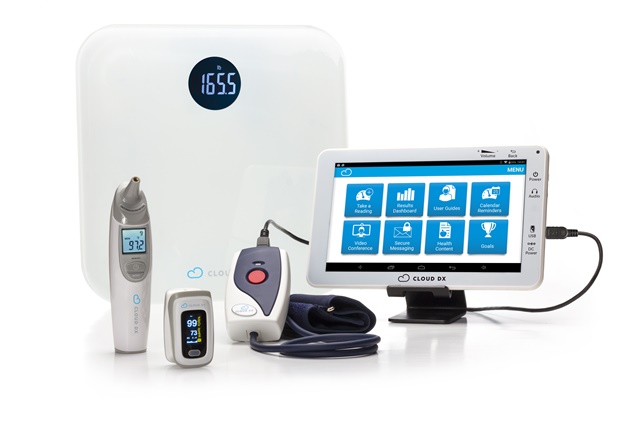
Imagine having a digitally connected mini examination room at your fingertips 24/7? Now you can. Another Canadian innovation, the Connected Health System, developed by Cloud DX, is now being used in doctor’s offices, clinics and in the home.
This “out of the box” health system contains easy-to-use monitoring devices so you can connect and undergo an online consult right from your living room in real-time. To track your vitals, the tool kit contains a wrist cuff device, a Bluetooth body-weight scale and a pulse oximeter, glucose meter, speaker dock, and an android tablet. The system’s software applications enable two-way communication between patient and care teams and provides audible schedule and medication reminders and referral and appointment options.
The beauty of this system is that it enables remote patient monitoring by physicians – a benefit for both parties. By keeping tabs on patients this way the care team can intervene early to change behavior, adjust medications or send a home-care nurse to make a house call. The goal is to keep patients out of emergency rooms and hospital beds and feel more in control of their health.
We are only scratching the surface here, there is no question innovation is disrupting healthcare delivery and the journey will continue to be an exciting one.
Stacey Palangio is a freelance writer.