HomeNews & TopicsEducation and Professional DevelopmentProfessional development for sustainability

Professional development for sustainability

Published on

By Christie Nairn

Healthcare employees are faced with life or death decisions every single day. The decision to recycle or turn out the lights when leaving a room usually is not top of mind for many of these same people. However, small behavioral choices such as recycling can make a real difference in a hospital’s environmental sustainability practices – which in turn affect the surrounding community’s health.

At HSC Winnipeg, Housekeeping staff are an indispensable component of the sustainability program. The department of 350 staff have the unique advantage of being the only population in the hospital who visit every room on the 32-acre campus every single day. They make a huge difference in the success of the sustainability program at HSC Winnipeg.

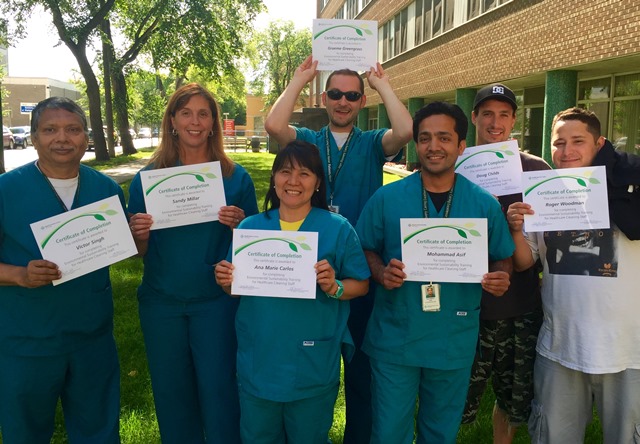
In spring of 2015, ten Housekeeping staff volunteered to be part of participatory professional development pilot project focused on environmental sustainability practices in healthcare. Throughout the 8-week trial period (one full day session, three half day sessions), Housekeeping staff explored the meaning of environmental sustainability, how it relates to human health, how it relates to their work at HSC Winnipeg, and what they can do to help improve practices within the hospital. The group decided that educating other housekeepers and staff was the best way to promote, encourage and improve sustainability initiatives on site. At the end of the professional development course participants worked together to create a one-page checklist, which would be included on all cleaning carts for housekeeping staff to view throughout their shift. The checklist covers important points such as turning out the lights when leaving the room, checking the taps to see if water is dripping and even ensuring waste and recycling are thrown in the correct disposal bins.

The staff who participated in the professional development session are proud of the work they conducted during the course. One of the participants even joked, “I used to not know anything about sustainability and now I know too much! I have to share this knowledge with my coworkers.” The group is now able to help to educate their peers about the importance of environmental sustainability and they are seen as champions of sustainability within their department at HSC Winnipeg.

HSC Winnipeg plans to create a condensed version of the course to other departments within the hospital, customized for how sustainability applies to different departments in the hospital.

Christie Nairn is the Environmental Sustainability Coordinator at Health Sciences Centre Winnipeg. For more information contact Christie Nairn at green@hsc.mb.ca.

Latest articles

New approach opens door to better-targeted treatments and faster drug discovery for complex diseases

McGill researchers have developed an AI tool called SIDISH that identifies high-risk cancer cells driving aggressive disease, enabling more precise and targeted treatment strategies. By linking single-cell data with patient outcomes, the tool can predict disease progression and simulate responses to potential drug targets, helping accelerate drug discovery and repurposing. While still in development, SIDISH shows promise for advancing personalized cancer care and improving outcomes across multiple tumour types.

Canadian Cancer Society urges lowering colorectal cancer screening age to 45

The Canadian Cancer Society is urging provinces to lower the colorectal cancer screening age from 50 to 45, citing rising rates among younger adults and evidence that earlier screening could prevent over 15,000 cases and 6,100 deaths. Younger patients are more often diagnosed at advanced stages, making early detection critical. Expanding access to simple screening tools like FIT tests could significantly improve outcomes and save lives.

Unleashing natural killer cells against cancer

Researchers at McGill University have developed a new strategy to enhance natural killer (NK) cells, enabling them to better penetrate tumour defenses and destroy cancer cells. Using small-molecule drugs to temporarily boost NK cell activity—rather than permanent genetic modification—the approach showed strong results against multiple hard-to-treat cancers in preclinical studies. The scalable, ready-to-use therapy could make immunotherapy faster, safer, and more accessible, with future clinical trials planned for aggressive cancers like acute myeloid leukemia.

Doctors report false health information, lack of health data sharing put patient care at risk

A new CMA survey reveals major risks to patient care in Canada, with 99% of physicians reporting that disconnected health systems limit access to critical patient information and nearly half witnessing serious adverse outcomes as a result. At the same time, 97% of doctors say they have intervened to address harm caused by false or misleading online health information, including AI-generated advice. The findings highlight the urgent need for integrated digital health systems and stronger efforts to promote reliable health information.

More like this

CARE Centre and Sunnybrook Health Sciences Centre Partner to Support Internationally Educated Nurses’ Integration

When CARE Centre for Internationally Educated Nurses (IENs) opened its doors 25 years ago,...

Innovative shower room design shown to ease distress in people with dementia

HN Summary • The Specialized Dementia Unit at University Health Network’s Toronto Rehab University Centre...

HHS reduces food waste to reduce greenhouse gases

HN Summary • Measuring and targeting emissions: Hamilton Health Sciences identified food as its second-largest...

New multi-sensory room brings calm and comfort to children and youth

The moment a child steps inside the room, soft lights twinkle across the walls,...

Building a greener, safer hospital

HN Summary • Sustainable, Low-Impact Design: The new West Lincoln Memorial Hospital (WLMH) in Grimsby,...

Empowering Canada’s health leaders for the AI era: The Health AI Academy takes learning coast-to-coast

HN Summary • Unity Health Toronto’s Data Science and Advanced Analytics team launched the Health...