
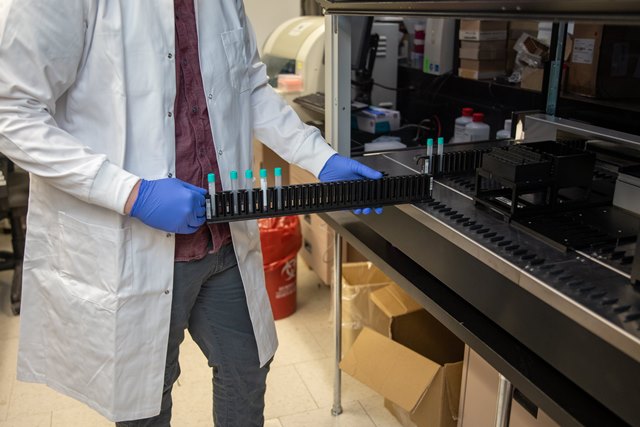

In a tucked-away lab at St. Joseph’s Healthcare Hamilton, a handful of scientists – and their robot “colleagues” – are leading the race to scale up COVID-19 testing to meet the demand of a surge in cases.
Alongside his team of molecular microbiologists, Dr. David Bulir of The Research Institute of St. Joe’s Hamilton is automating COVID-19 testing for greater volumes and faster turnaround times. For every 100 samples, Dr. Bulir’s robotic liquid handling system will be able to confirm results in just two and a half hours.
Once the system is developed and optimized, it will be rolled out for clinical use at the Hamilton Regional Laboratory Medicine Program (HRLMP) to enable COVID-19 testing to jump from 700 samples per 24 hours to about 1,500 samples over the same timeframe, and eventually more than 3,000 per day.
“These robots will help us get to the testing numbers that clinical labs are going to need in the next few weeks,” Dr. Bulir says. “They will alleviate the amount of processing humans do, while increasing the throughput at the clinical level.”
Dr. Bulir first started developing ways to detect the virus in January, at the cusp of the COVID-19 outbreak in China. From that, he has designed a highly sensitive test, which is now used by the HRLMP, and is sought after by – and implemented in – hospital labs across Canada and internationally.
“Located right here in Hamilton, our research and clinical labs have worked tirelessly to develop tests that are now being deployed locally, throughout Canada, and beyond,” says Dr. Marek Smieja, the interim chief of laboratory medicine at the HRLMP.
Dr. Bulir’s test is unique because it detects a part of the virus that is less likely to mutate, and is very effective at distinguishing between COVID-19 and other coronaviruses. This also means that as the virus evolves, changing its genetic code, Dr. Bulir’s test is expected to remain effective.
“Now that we can detect COVID-19, and detect it really well, our goal is to identify more people that have the infection. To do that we must increase the volume of testing, and the capacity to test quickly,” Dr Bulir says. “That’s our focus right now.”
Dr. Bulir’s work shows so much promise it was selected by a Scientific Committee at the Juravinski Research Institute to receive a boost of more than half a million dollars in funding thanks to a new $3.3 million gift from Hamilton philanthropists Charles and Margaret Juravinski.
The couple’s most recent donation, announced April 3, was designated in part to accelerate COVID-19 research across St. Joseph’s Healthcare Hamilton, McMaster University, and Hamilton Health Sciences.
Elaine Mitropoulos is a Public Affairs Specialist at St. Joseph’s Healthcare Hamilton.