

By Hayley Mullins
In 2012, I was practicing skin-to-skin (STS) with my two week old daughter, when I took my hands off her for a brief moment – in that split second she fell to the floor. Devastated and determined not to let it happen again, I tried the wraps, carriers, slings and baby wearing shirts that existed in the market at the time – nothing did what I wanted them to do, which was to literally belt my sleeping baby to me. Partnering with my sister, Ashley Wade, we brought a new product to life and introduced SleepBelt to the market in 2013. Within five weeks of launching, we received our first hospital inquiry, and an endorsement from la Leche League International. Based on clinician feedback, we made some slight alterations to the original product, and developed the more hospital-friendly Joeyband by SleepBelt.
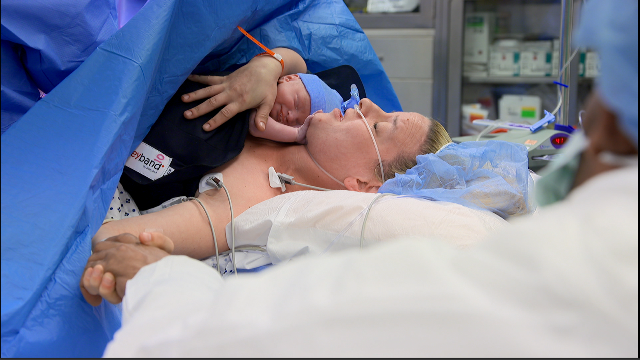
Having officially launched as a clinical product less than two years ago, Joeyband is now used in 100+ hospitals worldwide. The benefits of STS are numerous – it is linked to increased breastmilk production, better bonding, reduced post-partum depression, better infant sleep, temperature regulation, and brain development. The clinical evidence is so strong, that the World Health Organization recommends STS for all newborns, while the Baby Friendly Initiative calls for 60 minutes of STS within the first hour of life – a simple act that can be tricky in certain scenarios… like the OR. “New practice is to put the baby skin-to-skin immediately after delivery, but that gets a little dicey in the OR. We can use the Joeyband to secure the infant to mother’s breast and the babies will settle right down and if positioned at the right angle will nuzzle over and actually initiate feeding while the doctors finishing on the other side of the drape’” says Liz Seaman, RN, BSN, IBCLC, CCE of Bridgeport Hospital.
As part of linen prep, the Joeyband is laid out on the table under the mother’s back, above the sterile field. Once the baby is placed on her chest, the band wraps around and secures to the side with industrial-strength Velcro, keeping baby snug and secure – through repair, transport, and into recovery.
Even with routine births, STS is not without its hurdles – mom is exhausted, possibly medicated, and may be physically unable to hold her baby in proper position for the recommended time, and babies are at risk of falling… both out of position, or onto the floor, putting the infant at risk for skull fracture or suffocation.
Additionally, Joeyband can help support extended kangaroo care in the NICU. The design easily supports twins, is gentle enough for micro preemies, and doesn’t interfere with medical lines.
Joeyband by SleepBelt is enhancing the birth experience – patient satisfaction scores are increasing, as parents are provided a simple tool to make the first 24-hours of life easier, safer, and calmer. This simple product is well on its way to becoming standard of care in birthing hospitals everywhere and it started right here, in Canada.
Hayley Mullins is the Toronto-based co-founder & inventor of Joeyband and its retail counterpart, SleepBelt.