
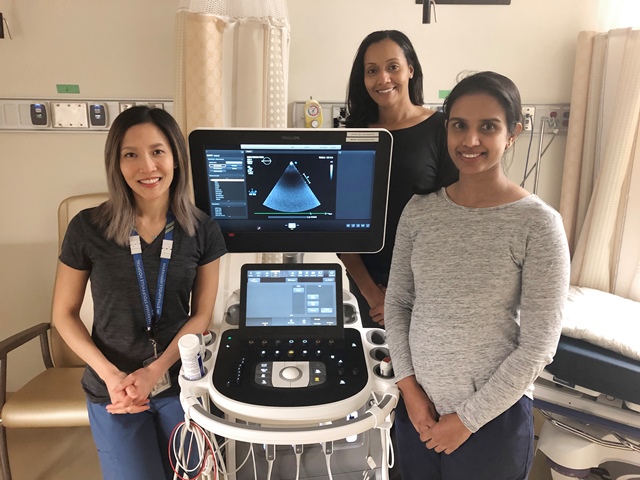

By Lynne Campkin
Markham Stouffville Hospital (MSH) recently expanded its cardiology programs which have resulted in an increase in patients who require more complex care. In order to serve these patients, high quality images of the heart, blood flow and fine anatomic detail are needed by cardiologists to make confident and specific diagnoses from echocardiograms. Dr. Joseph, Minkowitz, Lead Cardiologist at MSH, recognized a gap in the current system that made it more difficult for care providers to access these high quality images. He advocated for an improved electronic platform to address this gap and better serve the current and future growth of cardiac programs at both the Markham and Uxbridge sites.
The MSH diagnostic cardiology and information technology teams set out to find a software solution that would enable the ideal workflow from order entry to signed cardiologist consultative report and deliver high quality images maximizing both temporal and spatial resolution captured at the bedside.
Echo equipment continually improves and MSH sonographers attain spectacular images in fetal, pediatric and adult echocardiography. When the imaging chain is extended through the use of software and networks to transmit images for interpretation it is important to ensure excellent image quality at staff workstations in the hospital and at each cardiologist’s desktop in the various locations that they work from.
MORE: LEVERAGING TECHNOLOGY TO ENHANCE THE PATIENT EXPERIENCE
In November 2018, MSH upgraded to the Siemens Syngo Dynamics electronic image management software to optimize integration with their GE and Philips echo equipment. This provided seamless workflow for each clinical team member and ultimately enhanced patient care, customer service and team productivity. With this implementation, there has been a significant improvement in the time to send images to cardiologists and in overall report turnaround time.
“The Syngo Dynamics integration with Meditech and the echo equipment helped with standardizing an improved structured report for both internal and external referring clinicians and enhanced work flow for the sonographers and cardiologists,” says Dr. Shruti Tandon, MSH Cardiologist. “The whole care team is more productive which means we can provide more timely care to more patients.”
Having the whole image-to-report process fully digital replaces the intense manual process of recording important information in patient studies. “My team finds the case specific notes section a valuable communication tool that enables an exchange of relevant qualitative information for the interpreting cardiologist.” says Jennifer Martin, Lead Echocardiographer at MSH. “I love the ability to easily recall any patient’s full dynamic echocardiogram at any Meditech workstation throughout the day without interrupting patient care on the echo machine.”
Cardiologists often need to refer to previous patient studies; in the past this meant searching through CD records which did not have easy search functionality. “The new reporting system is fast, enables patient study retrieval in full resolution to support education rounds and most importantly, delivers high quality, dynamic images for review and interpretation” says Dr. Jonathan Lu, MSH Director Echocardiography Laboratory.
Finally, the clinical and technical system administrators and department leaders are happy with the ease of implementation, vendor product knowledge, easy retrieval of archived patient studies, and cost per case analysis.
The future sustainability of the health care system depends on improving quality while growing capacity and saving valuable dollars. This digital improvement project achieved all of these requirements; delivering hard wired systems supporting scalability, accuracy and efficiency for a low cost per case.
Lynne Campkin is Director, Diagnostic and Laboratory Services at Markham Stouffville Hospital.