

HN Summary
•Supporting youth mental health: Sunnybrook’s SunRYSE program offers a summer, camp-like experience for teens aged 14–18 with significant mental health challenges, helping them earn school credit and build life skills.
•Holistic care approach: The program combines academics, fitness, therapy, life skills training, community outings, and parent involvement to support both youth and families in managing mental health.
•Proven impact and growth: Now in its second year, SunRYSE has shown life-changing results, enabling youth to re-engage socially and academically, with hopes the model will expand across Ontario and beyond.
This past summer, Sunnybrook’s Department of Psychiatry welcomed back Toronto youth as part of the second cohort for SunRYSE, a hospital-community partnership with the North Toronto Ontario Health Team, Toronto Catholic District School Board, Sprint Senior Care and Pine River Institute.
Youth aged 14-18 who are experiencing functionally impairing mental health challenges, can participate in the one month, summer camp-like experience to earn a high-school credit, and develop life skills that will help them navigate their physical health, emotions and mental health challenges.
Tailoring mental health care for youth
The SunRYSE program is unique from other short-term mental health programs, which are typically aimed at helping adults. Youth who are experiencing mental health issues are likely still trying to figure out their diagnosis and how to manage it, all while juggling the difficult challenges and pressures that come with being a teenager.
“Many of the children in the SunRYSE program experience complex mental health challenges, like social anxiety, which has resulted in them being disconnected both academically and socially,” explains Dr. Rosalie Steinberg, Deputy Chief of Psychiatry and Co-Director of Quality Improvement in the Department of Psychiatry at Sunnybrook. “The SunRYSE program promotes new learning and a safe environment to help youth with their mental health challenges, before they fully develop and create lasting complications into adulthood.”
Practical programming that supports the whole patient
There is no one-size fits all for mental health care. The SunRYSE program takes a holistic approach, providing participants with a wide range of academic, fitness, dialectical behaviour therapy, life skills and exposure therapy. Students also go into the community to apply their skills and prepare them for life outside the program. Participants have field trips to grocery stores and malls, where they learn to interact with staff and decide on items to purchase.
SunRYSE also offers education and support for parents and guardians of participants in the program through its partner Pine River Institute, so that they’re better equipped to support their child’s mental health.
“Parent participation in the program plays an equally important role in the child’s growth and management of their mental health,” adds Rosanna Di Nunzio, Patient Care Manager in the Department of Psychiatry. “Participants can feel supported after completing the program knowing their parents are invested in their mental health journey.”
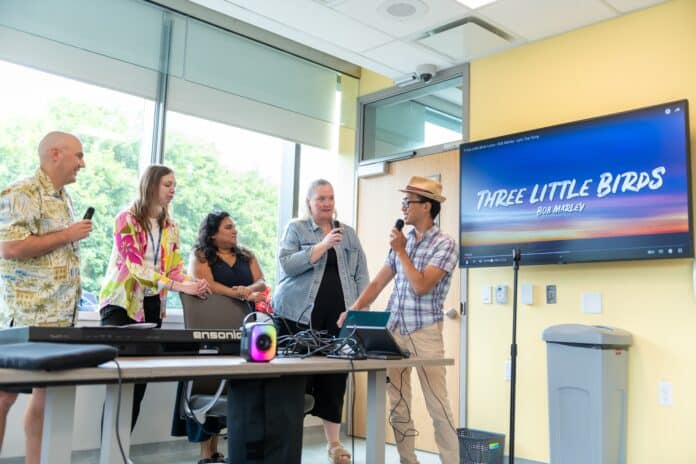
Students and staff celebrated the end of the program and had the opportunity to showcase their growth with parents, peers and staff at the SunRYSE Talent Show, which was organized, hosted and performed entirely by the students. The SunRYSE participants entertained the audience with magic tricks, artwork, piano, TED Talks and a round of Name That Tune.
Hope for the future of mental health programming
The SunRYSE program has just completed its second year, after a successful pilot in 2024. For past and present participants, the experience has had a life-changing role in their mental health care journey, enabling them to return to school and other social activities.
“It’s incredible to see the progress the kids make over the course of the program,” says Dr. Karen Wang, who co-leads the SunRYSE program and is the Medical Director of the Inpatient Youth Unit at Sunnybrook. “You can really see the impact of the program through the joy on the students’ and clinicians’ faces.”
The SunRYSE program is a unique model to Sunnybrook, with exceptional partnerships across multiple sectors. The program coordinators hope other organizations can learn from this model and choose to implement similar programming so the benefits reach more youth across the province and country.