
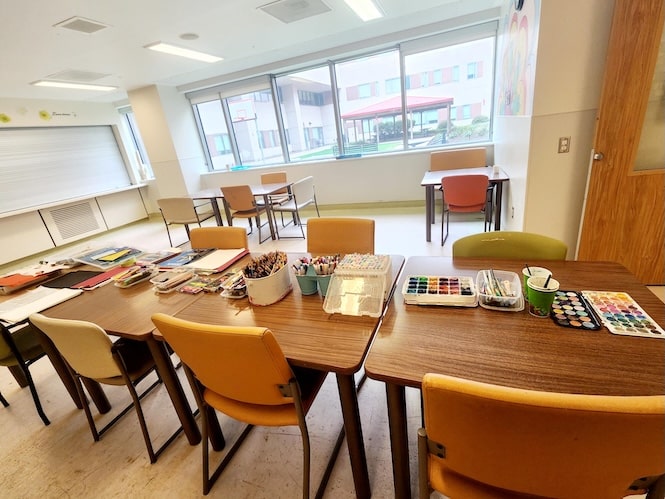

If you walk the halls at St. Joseph’s Healthcare Hamilton, you’ll see some of the walls blooming with colour. What was once sterile and beige now comes alive. Shades of green, gold, soft blues, and bright hues stretch across the walls like hope, a hope the staff provides on a daily basis.
We’ve come so far in treatment, awareness, and compassion in mental health care. Yet one thing hasn’t changed enough: too many hospital spaces still look and feel clinical, with cold walls, harsh lighting, and rooms that feel more like a containment than a place of care.
But when art enters those spaces, a profound transformation occurs. The walls begin to speak, and they say, “We care enough to add colour here. We see you. You’re not alone.” This transformation instills a sense of hope and belonging.
Throughout history, some of the world’s greatest creators have lived with mental illness: Vincent van Gogh, Georgia O’Keeffe, Edvard Munch, Jackson Pollock, and Sylvia Plath. Their work showed us that art is not separate from illness; it often rises from it. Creativity can be a matter of survival, but it can also be a catalyst for transformation.
I am both a teacher and an artist, but I am also someone who lives with Bipolar 1 and OCD. I know firsthand how art can heal and say things words cannot.
My first hospitalization was in 2009. I remember the locked unit, the stillness, the sterile walls. My only brush with colour was what I saw through a window I couldn’t open. I watched life move outside while wondering if I’d ever go anywhere in life with my diagnosis.
My fifth and final admission was in 2015, made possible in part by ECT treatment. As my Bipolar Depression lifted, I realized art wasn’t just something I loved, it was how I stayed alive.
For most of my life, art has given me an outlet, a voice, and a way to feel seen.
Now I walk back through those halls as an Expressive Arts Facilitator, grateful to be seen for what I can share, and hopeful that art will help others feel seen too.
In February, I led a mural project with staff, peers, and patients at both the Community Psychiatry Clinic and Womankind at , two St. Joe’s programs that support individuals at crucial turning points in their recovery. It was made possible by the unwavering support of Manager Catherine McCarron and Director Heather Radman, who understand that healing is not solely a medical process. Their belief in the power of art and their commitment to patient-centered care helped bring these murals to life.
Every brushstroke told a story. One patient painted grass moving in the wind. Another focused on the green of a single leaf. Others created flowing water, while the final touches came in small glimmers of gold leaf pressed into the paint.
They weren’t just painting. They were proving something, that even within darkness, there is room for creation. Their stories, their struggles, and their triumphs were reflected in every colour.
Following the success of those projects, Managers Sharon Simons and Taralynn Filipovic, along with Director Heather Radman, approached me with a new challenge: to bring that same hope directly into Inpatient Acute Psychiatry. I would be teaching those standing in their most challenging moments.
I have now witnessed the impact of art in acute care. As I roll my cart into the locked unit with a smile on my face, I watch guarded faces soften. Art supplies and music replace fear with possibility.
There is a shift that happens when someone is seen as a creator instead of a case file. In that moment, art becomes more than an activity; it becomes proof that they still have agency, still belong, still have beauty left in them to show the world.
I understand the depth of their despair because I have stood in it, the disorientation, the loss of identity, the fear of never returning to oneself. That is why I continue to teach in these settings: art is an invaluable tool for ongoing wellbeing.
I once told myself that if I recovered, I would never set foot in that hospital again. But Manager Sharon Simons, who has long fought to bring art into hospital settings, had other plans for me. In 2017, she hired me while I was still an outpatient. Where I saw myself as a problem, she saw potential. I had always been an artist, but she helped guide me on my journey to becoming a teacher and an advocate. She believed in me long before I believed in myself and carved out a space in the hospital where I could begin to redefine who I was.
At St. Joe’s, we are breaking barriers, not just in how hospitals look, but in how hospital relationships are defined. These murals don’t just change the walls; they change the dynamic. They create a place where staff, peers, and patients stand at the same level. When we hold brushes, there are no titles. Only people.
Even at the highest level of leadership, that shift is unmistakable. Randi McCabe, Vice President, has been clear, seeing people as whole human beings, not diagnoses, is essential to the future of mental health care, and creative, lived-experience-led programs are part of that change
To move forward in mental health care, we must keep rewriting what recovery looks like. Sharon did that when she hired an artist who knew what it felt like to be a patient as well. Now it is my responsibility to help shape what recovery can look like for others.
Healing may begin under fluorescent lights, but it truly flourishes in comfort, connection, colour, and compassion. These women in leadership are helping make that a reality. They are colouring outside the lines of traditional care and creating spaces where more individuals, like me, can succeed in their passions and ongoing recovery.
Each time I step back into those halls, I think of the woman who once entered in pieces, unsure if she’d ever return whole. I did return, formed into this mosaic of wellness by everyone who cared for me. Now, when I see the murals we’ve left on the walls, I hope every patient who passes by sees what I see…proof of what’s possible.
I was cared for within these walls when I could not care for myself. Now I carry that care forward, paintbrush in hand. I teach so that others may find their own brush, their own story, their own way back. That is how recovery grows, not alone, but side by side, painting a future brighter… together.
April Joy Mansilla runs Mental Well-being Art Classes, For more information, visit www.aprilmansilla.com