HomeNews & TopicsEducation and Professional DevelopmentWellness Certificate Program helps hospital staff commit to self-care

Wellness Certificate Program helps hospital staff commit to self-care

Published on

By Emily Holton

A new, one-year certificate program at St. Michael’s Hospital offers clinical and administrative staff a different kind of professional development: how to support one’s own wellness.

“To me, wellness is not just about the absence of disease,” says Shivalee Paliwal, the performance and wellness consultant leading the program. “I’m talking about helping people reach their full potential for physical, mental and social well-being.”
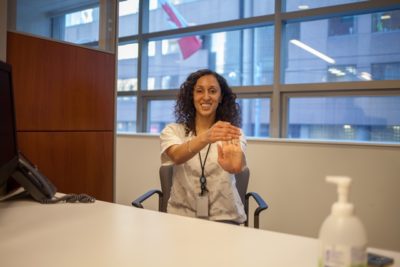
: Shivalee Paliwal, a performance and wellness consultant, demonstrates “chair yoga.” (Photo by Yuri Markarov)

Paliwal believes that when staff’s wellness improves, so do organizational outcomes – it’s in everyone’s best interest to nurture wellness at work. Her goal is to equip staff with the tools to better navigate stress, improve their physical and mental health and have stronger social interactions.

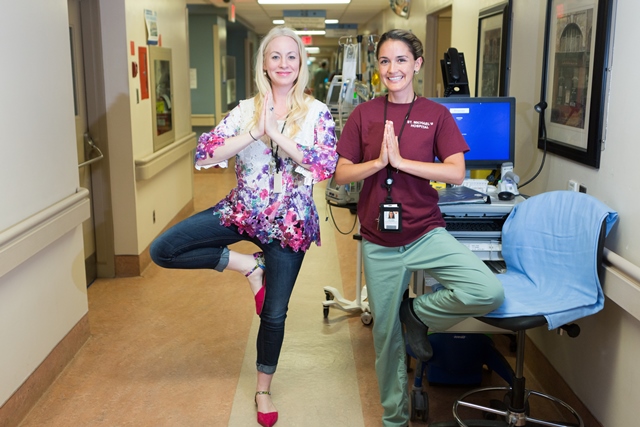
She began with weekly “chair yoga” and lunch-hour guided-meditation sessions in spare meeting rooms.

“I put the call out in our staff newsletter, hoping at least one or two people might show up,” says Paliwal. “It’s been so exciting to see such a great turnout every week, and a clear desire among staff to explore these topics more deeply.”

In response, Paliwal has developed the I Am Wellness certificate program. It’s a series of 10 workshops offered to staff free of charge through St. Michael’s Human Resources and Corporate Health and Safety Services. Topics include breathing and posture, meditation and mindfulness, building resilience and cultivating gratitude.

Participants can join as few or as many sessions as they wish, but those who participate in all 10 sessions will receive a certificate of completion.

A homework component is central to each workshop. It asks participants to pick a daily, personal practice and stick to it for 30 days. Examples include five minutes of deep breathing, or a few pages of journal writing.

“It’s about forming habits,” says Paliwal. “People vary largely in how long it takes them to stick to something, but 30 days is long enough to see impact and help them decide how they want to proceed afterwards.”

A similar St. Michael’s initiative is evaluating a toolkit of wellness techniques and approaches designed specifically for nurses. The ARISE project offers in-hospital workshops, online sessions and a closed Facebook support group to see if they can enhance resiliency for up to 40 trauma and acute care nurses.

The self-care topics are taught by St. Michael’s clinicians with special interest in supporting workplace wellness.

“ARISE was built within St. Michael’s, with our people and for our nurses,” said Orla Smith, an associate scientist at the Li Ka Shing Knowledge Institute of St. Michael’s Hospital and the clinical leader manager for the Cardiovascular Intensive Care Unit. “Because the project is tailored to our nurses it understands and reflects the context of our mission, values and patients. It was designed for the reality of the bedside nurse and their unique needs related to health and wellness.”

Like the I Am Wellness program, the ARISE program focuses on self-care and stress-relief techniques such as yoga and mindfulness.

“This concept of wellness is so often misunderstood,” said Paliwal. “Many believe it’s something for people with too much time on their hands, or a hobby to pursue after work. However I’ve seen how transformative these practices can be, no matter who you are or what your lifestyle may be. Everyone can benefit.”

Emily Holton is a Senior Communications Advisor at St. Michael’s Hospital.


Latest articles

New approach opens door to better-targeted treatments and faster drug discovery for complex diseases

McGill researchers have developed an AI tool called SIDISH that identifies high-risk cancer cells driving aggressive disease, enabling more precise and targeted treatment strategies. By linking single-cell data with patient outcomes, the tool can predict disease progression and simulate responses to potential drug targets, helping accelerate drug discovery and repurposing. While still in development, SIDISH shows promise for advancing personalized cancer care and improving outcomes across multiple tumour types.

Canadian Cancer Society urges lowering colorectal cancer screening age to 45

The Canadian Cancer Society is urging provinces to lower the colorectal cancer screening age from 50 to 45, citing rising rates among younger adults and evidence that earlier screening could prevent over 15,000 cases and 6,100 deaths. Younger patients are more often diagnosed at advanced stages, making early detection critical. Expanding access to simple screening tools like FIT tests could significantly improve outcomes and save lives.

Unleashing natural killer cells against cancer

Researchers at McGill University have developed a new strategy to enhance natural killer (NK) cells, enabling them to better penetrate tumour defenses and destroy cancer cells. Using small-molecule drugs to temporarily boost NK cell activity—rather than permanent genetic modification—the approach showed strong results against multiple hard-to-treat cancers in preclinical studies. The scalable, ready-to-use therapy could make immunotherapy faster, safer, and more accessible, with future clinical trials planned for aggressive cancers like acute myeloid leukemia.

Doctors report false health information, lack of health data sharing put patient care at risk

A new CMA survey reveals major risks to patient care in Canada, with 99% of physicians reporting that disconnected health systems limit access to critical patient information and nearly half witnessing serious adverse outcomes as a result. At the same time, 97% of doctors say they have intervened to address harm caused by false or misleading online health information, including AI-generated advice. The findings highlight the urgent need for integrated digital health systems and stronger efforts to promote reliable health information.

More like this

CARE Centre and Sunnybrook Health Sciences Centre Partner to Support Internationally Educated Nurses’ Integration

When CARE Centre for Internationally Educated Nurses (IENs) opened its doors 25 years ago,...

Empowering Canada’s health leaders for the AI era: The Health AI Academy takes learning coast-to-coast

HN Summary • Unity Health Toronto’s Data Science and Advanced Analytics team launched the Health...

Training that saves lives: Using simulation to strengthen teams and patient care

Over the past three years, simulation activity at Providence has increased by 30 per...

A national leader in specialized training for nurse practitioners

HN Summary • Hamilton Health Sciences launched Canada’s first nurse practitioner fellowship in hematology, marking...

Sunnybrook welcomes third cohort of work-integrated learning students

HN Summary • Sunnybrook welcomed its third cohort of Black students through York University’s Work-Integrated...

St. Michael’s Hospital endoscopy training program draws experts and students from around the world

HN Summary • Participants from around the world took part in North America’s oldest and...