
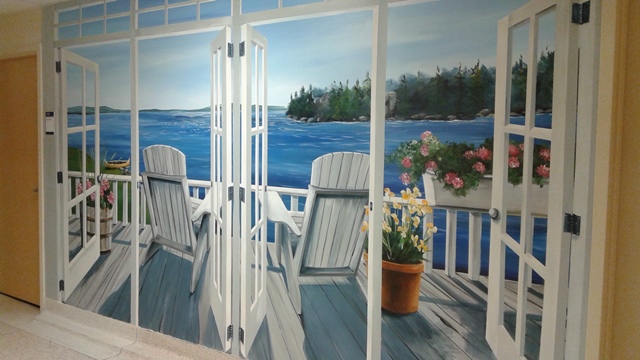

Wandering and looking for a way out is a common tendency for elderly adult mental health patients with dementia, where a patient sees a door, and wants to pass through it by instinct. Elderly patients with cognitive impairments who are admitted to a hospital mental health ward often exhibit behavioural disturbances. According to research, it’s hard to say what in particular might cause a patient to wander while in hospital, though for most patients who spend a prolonged amount of time in hospital, the motivation is often a change of scenery.
Drawing from her previous experience in a Long-Term Care home, Nicole Rodney-Hare had an idea. As the Clinical Manager of Geriatric Psychiatry at #Trillium Health Partners, Nicole knew that installing attractive, professionally drawn murals designed to disguise the exits on the hospital’s Seniors’ Mental Health Unit would remove the stress of exit-seeking for patients, and would instead promote a calming environment with less anxiety, less stress, and ultimately, a better #patient experience. Local painter Susanna Lamy was hired to paint the murals.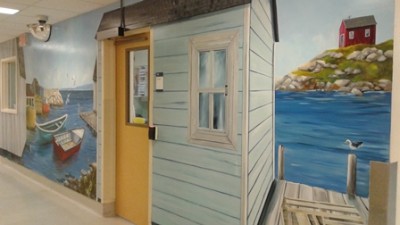
“Knowing how culturally diverse the Mississauga community is, I wanted to pick a theme that everyone could relate to. I decided on painting typically Canadian scenery. I chose themes like the Muskoka cottage patio, and the East Coast ocean view, especially because I know how soothing watching water can be. I also felt many people could relate to gardening and nature, and by painting a garden mural, I wanted to bring that back to them so they could imagine they were sitting in their garden. I tried to incorporate physical surroundings in such a way that the murals appeared believable, giving patients the sense that the scenery on the painting was truly a part of their surroundings,” Lamy said. “It’s great to do a mural on a restaurant wall, but it doesn’t have the same impact – here, I could see I was creating something that really impacts someone’s health, recovery and overall patient experience,” Lamy added.
MORE: KEEPING UP WITH THE SENIORS
“Since the murals went up, we no longer have patients standing at the exit doors, waiting for them to open. The area has become more of a conversation rather than a place of high risk behavior,” said Rene Turner, Manager, Seniors’ Mental Health Services, Trillium Health Partners. “The murals have helped us to create a warm, home-like, low-stress environment. This has helped to reduce agitation and exit seeking behaviours, and created a space which promotes wellness and a positive patient experience,” Turner said.
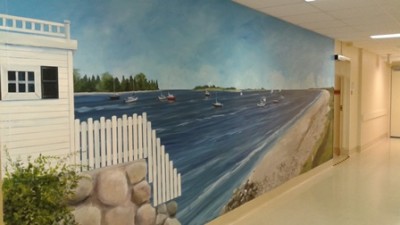 Joan Heck visits her husband at Trillium Health Partners’ Mississauga Hospital every day, where he is currently staying while he waits for a Long-Term Care placement. “I always see patients near the murals, enjoying them, pointing things out. Once, I even saw a lady stop at the garden mural and try to pick a flower. People really connect to the visual experience – they think they are looking at a real place. The exit doors are hidden so well, patients no longer stand there. Without the paintings, my husband would definitely be standing at the doors every day. They make a big difference,” Joan says.
Since the murals were installed within Trillium Health Partners’ Mississauga Hospital Seniors’ Mental Health Unit in June of 2015, there has not been a code white on the unit, and exit seeking has been reduced from daily to almost none. Trillium Health Partners is currently expanding the murals project to other areas of the hospital, including its Mental Health Unit and Intensive Care Unit.