

By Courtney Kraik
The textbook definition of a Mass Casualty Incident (MCI) is an event where the number of patients vastly exceeds the resources of what the local health care resources can provide over a short period of time. Not all MCIs look the same, but this equation is constant.
For Ornge, Ontario’s provider of air ambulance and related services, such an event puts all aspects of the operation suddenly to the test.
On February 2, 2018 a coach bus carrying a group of high school students was travelling southbound on a rural highway through the small community of Stayner, Ontario just southeast of Collingwood. At around 1:30 p.m., a northbound van on the same highway occupied by six children and two adults crossed the line and collided head-on with the coach bus. The reason was unknown – poor road conditions were often cited in media reports – but the outcome was acute.
Information about the incident was first relayed through the London Central Ambulance Communications Centre (CACC) on behalf of the Georgian CACC. The two areas share a boundary close to the incident. Two first responder units on scene initially reported as many as a dozen possible paediatric patients. Georgian CACC and the Operations Control Centre (OCC) at Ornge officially declared the crash an MCI and the CACC requested “as many helicopters as you can send.”
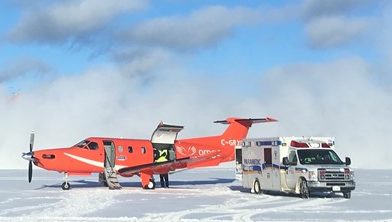
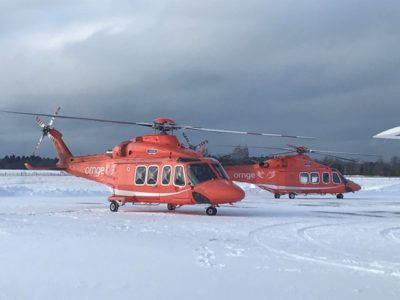
As it turns out, this call response involved more than just helicopters. Two fixed wing air ambulances based in Thunder Bay and Sioux Lookout happened to the in southern Ontario at the time and were diverted to the Collingwood airport. Ornge also sent three land ambulance units including the Critical Care Transport Unit with Toronto Paramedic Services. Three helicopters from Ornge’s Toronto and London bases were dispatched.
In under an hour, six separate emergency health care agencies were working in tandem to provide critical pre-hospital emergency care.
Once an MCI is declared in the OCC in conjunction with a responding CACC, workloads of assets and communications officers are reassigned within the OCC itself. Triage decisions result in some non-urgent inter-facility transports being put on hold temporarily as teams are re-routed to the scene.
Ornge’s helicopters are the most commonly used assets when responding to scene or modified scene calls because of their speed and versatility. When the request went out for assets to be sent to Stayner, an Ornge team was in the process of transporting a non-urgent transfer patient at a tertiary hospital. The Transport Medicine Physician in the OCC spoke urgently with the sending facility’s intensive care physician to arrange a delay in the transfer so the helicopter could be re-routed to the scene.
“Once we have a patient in our care, that’s it, they’re ours. We’re responsible for their safety,” says Fabiano Medungo, the Operations Control Manager on duty that day. “The fact that we returned that patient to the sending facility to be transported at a later time really spoke to how serious the situation was in Stayner.”
Meanwhile in Stayner, patients were being triaged at Collingwood General and Marine Hospital and stabilized for transport to acute trauma centers. In a stroke of good luck, if there could be such a thing on a day like that, one of Ornge’s Transport Medical Physicians, Dr. Doug Chisholm, was on duty at CGMH. Having worked with Ornge paramedics for a number of years, his presence made the transport decisions easier as the teams began arriving in the area.
“Normally the transporting teams know roughly what condition the patient is in before they get there,” says Medungo. “In this case, no one knew anything. There were so many patients it was difficult to assign a particular patient to a specific team. Having Dr. Chisholm there to triage and delegate patients to exact teams was a special circumstance, but absolutely crucial as he has an intimate understanding of our paramedics’ scope of practice.”
In total, seven critical patients were transported by Ornge to trauma centers in the Toronto area; two adults and five paediatric patients.
Events as extreme as this one don’t generally get rated on a scale of success or failure. Patient outcomes and excellent care management are what matter to all the teams at the end of the day. This involves extraordinary teamwork, organization and communication among emergency workers at the scene, the hospital, dispatchers and crews. For the air ambulance crews, it also involves some good fortune like favourable weather and available aircraft in the area.
Things rarely go according to plan, but the anatomy of this mass casualty incident was as seamless as it gets.
Courtney Kraik is a Communications Intern at Ornge and a student in the Paramedic program at Georgian College.